Showing posts with label Light Rail Transit. Show all posts

Wednesday, February 9, 2022

Auckland Light Rail – Sinking a Tunnel or Sinking a City?


Light Rail: A solution in search of a problem

Auckland has seen that the creation of commissions, teams, or working parties to implement simple-minded solutions to complex problems allows little room for debate on alternatives.  Like the creation of the supercity and Auckland’s Central Rail Link, the proposed CBD to Airport tunnelled light rail is a solution in search of a problem.

In Tuesday’s NZ Herald economist Tim Hazledine strips Auckland’s congestion problem back to basics. He raises some facts that seem to have been overlooked: the limited nature of the problem, the availability of congestion pricing to resolve it, the changing of CBD work, the low utility of a service stopping at 18 stations over a short distance, and Auckland’s “topsy turvey topography”.

There's not a lot to add to his critique, but here’s some more on the environmental issues and changes in Auckland’s growth, both of which render the LRT already obsolete.

Climate Emergency: Yeah?  Nah?…

In 2019 Auckland Council declared a Climate Emergency. In January 2022 the Government announced new light rail (LRT) from the CBD to Auckland Airport, flying in the face of that declaration: risk maps (1) put the LRT terminals, the airport and the CBD’s Western Viaduct, below the annual flood level before the end of the 60-year horizon used to justify it.

Inundation Prospects 2080: Auckland CBD and Airport
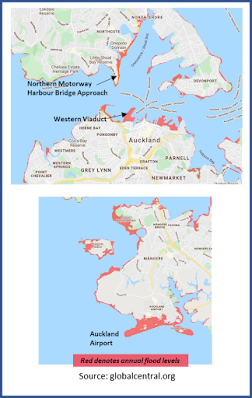

Even without sea level rise and with heroic assumptions about Auckland’s growth (more on that below), the project makes no economic sense. An abysmally low return, the likelihood of delays, and inevitable cost blowouts will undermine productivity.

And on the environmental front, tunnelling and the demand for concrete and steel will boost medium-term CO2 emissions despite the declared climate emergency (2).  The project may not even achieve a net greenhouse reduction before flooding at both ends of the line stymies its operations. (3)

So, there is an elephant in the tunnel.

It gets worse.

The Minister of Transport also announced another major construction project, a “second” harbour crossing, predictably endorsed by lobby group, Infrastructure New Zealand.  

The new crossing will  parallel the Auckland Harbour Bridge and share its northern approach. Unfortunately, this portion of State Highway One road already floods in severe storms. Given that it will flood more frequently as the sea level rises and storm events increase, the planned crossing will do little for network resilience. (4)

(We should mention that there is already a second crossing. Between West Auckland and North Shore, it will not be directly affected by climate change because its approaches are well above sea level).

Tunnel-vision

Acknowledging a Climate Emergency should lead to reconsideration of urban form and infrastructure to deal with the structural drivers of emissions. Current plans for excessive public investment will provide disproportionate private benefits to the small minority of Auckland’s households and businesses that benefit from the operation of fixed-route, heavily subsidised  transit services. Turning attention, instead, to land use and the relationship where most people live and work (which is clearly not the CBD) should lead to more much equitable urban form and investment outcomes. 

The government, the council, and its agencies should be revising their long-term plans to recognise the reality of climate change and shifting urban form, and aim to reduce transport demand without penalising mobility. Instead, their aim seems to be to cement in historical city form in the face of unprecedented climate change .

The plans will seriously disrupt lives and, through poor use of capital and crowding out better investment, undermine productivity. On the plus side (?), they should sustain an oligopolistic civil engineering and infrastructure sector and prop up CBD and on-route property values. 

Incidentally, climate myopia is not confined to the public sector. It’s fascinating to see businesses taking up new, ”green” commercial space in downtown Auckland’s future flood zone, while vacancies increase in the elevated uptown offices they are abandoning.

Auckland at a tipping point

We need to acknowledge another elephant.

With Covid people think about a new normal in terms of public health. Equally significant, though, Covid has accelerated shifts already changing Auckland’s growth path. Consider the combined impacts of:

·         A cyclical downturn in immigration, which commenced in 2018, accelerated under Covid;

·         A wage-disadvantaged economy will prolong the migration deficit beyond the “Covid effect”;

·         Technology advances and changing work practices undermining central city growth;

·         Land, service, and congestion costs leading to the decentralisation of industry;

·         Changes in attitudes to work, careers, and lifestyle reshaping how and where people want to live, and where and when they want to work;

·         A continuing population push out of Auckland;

·         Technology changes in the distribution of goods (bar codes, robotics, consumer-focused logistics) and services (decentralisation and democratisation through IT and AI);

·         An increasingly obsolete 20th Century model of urban and commercial hierarchies behind Auckland’s long-term planning.

Auckland is unlikely to grow to match the bullish projections used by the current crop of city planners and builders.  Nor will urban design based on debatable assumptions about where people should live and work. 

Revising urban form - planning for dispersal

With or without climate change, it is time to ease over-investment in that ageing tiara, the city centre, and put more into our scattered diamonds, emerging urban villages, and our pearls on a string – the centres of Wellsford, Warkworth, Drury, Pokeno, Tuakau, and the like – north and south of Auckland.

It is time to focus investment on the infrastructure and amenity needs of a range of urban centers rather than on mindlessly sinking public funds into the CBD. This means developing and maintaining well-balanced, localised land use and services. On the transport front, decentralised investment can facilitate more active travel options and demand-based vehicle sharing. Flexible bus options can operate both within and between centres, the latter on strong corridor connections among them.

Fortuitously, supporting dispersal within and beyond the city means spreading the risks associated with climate change and adopting defensive rather than intensification strategies on the waterfront. 

Dealing with the risk of climate change

Of course, that’s just an opinion from outside the tent.

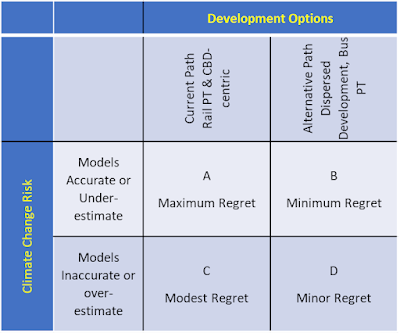
But here's my take on these diverging scenarios in the form of a risk/regret matrix.  The risks (“How likely are the climate change projections?”) fall on the vertical axis, the planning options on the horizontal axis (“Which development path shall we take”?)


The case for changing direction

The current investment path (which leads to cell A or C) looks wrong.  If we stay with it and the models are about right, we will write off a lot of investment and lower our ability to react to the impacts of climate change (Cell A). Even if the climate settles, we may still look back with regret at misplaced and under-costed commitments (Cell C). 

If, on the other hand, we shift to dispersed and flexible investment and the climate remains benign (Cell D), we would at least have a policy framework that should cope well with slower growth and reduce inequities within the city.

Finally, if we are fully exposed to the rigours of an unstable climate, then catering for dispersed development and opting for flexible public transport would provide the resilience and capacity to bounce back from climate disruption (Cell B).  The consequences of climate change may not be pleasant, but we will be better placed to deal with them. There will be regret – it’s too late to wind back the climate change clock – but we will have done our best to minimise it.

By the way …

Globally, the money-printing presses are grinding to a halt. The prospect that inflation will ease central and local government deficits will be offset, in part, by rising interest rates.  Money is no longer free, or debt without consequence. The case for major transport projects must be robust rather than shaky, definitive rather than indicative.

Proceed with the LRT and Auckland’s Climate Emergency will generate a fiscal crisis and see the integrity of Auckland’s infrastructure undermined as the promise and pressures of growth diminish, fiscal and financial liabilities increase, and the sea encroaches.


[1]           Based on the 2021 IPCC global warming consensus

[2]              For example, cement releases over 0.5tCO2/tonne and steel over 1t/tonne produced.

[3]              The Technical Appendices behind the Indicative Business Case, including Carbon Assessment, are not yet                      published.

[4]              Flooding could be offset by extensive and expensive raising of the road (State Highway One), some of which will       be needed anyway to keep the existing bridge functional. Expanding it at the same time, over 8km of vulnerable           shoreline, raises a whole lot more issues (and costs). though.

Wednesday, June 24, 2020

End of the line for Auckland light rail?


Rethinking the future
While New Zealand has restored modest levels of domestic activity following the Covid19 outbreak, prospects for full recovery are undermined not just by continuing border threats, by the twin blows of falling global trade and rising global indebtedness. Even if the country remains largely virus-free, it faces ruptures to the economy and employment, migration and housing, commuting and travel. Under these circumstances many of the shovel-ready projects placed before Government for funding may be of minimal long-term value, leading instead to additional fiscal strain and lower productivity.

It is time for a real rethink.

Rethinking Auckland’s Public Transport
This post suggests that Auckland can no longer afford to indulge in think big public transport projects. First, it again flags the need to shelve Auckland’s Central Rail Link. 
It then lists the documents supporting various light rail rapid transit options, which led to the questionable government commitment to light rail, reflected now in the postponement of the Minister’s decision on who might build light rail to the airport.  But if that decision is made in due course, this would lead to a greater fiscal disaster than the CRL. LRT should now be jettisoned.
Instead, it may be time to revisit the prospect for a modern, bus-based transit system to better respond to major shifts in demand and reduce the exposure of ratepayers and taxpayers to a fiscal black hole.


Back track on this one first
For starters, it makes sense for Auckland to follow economist Tim Hazeldine’s advice and pull the plug on Auckland’s Central Rail Link. The cost of shelving it should be far less than the cost of completing it.


As for LRT, do not even get started
It also makes sense to abandon plans for light rail transit. A solution in search of a problem, there was never a robust case for it.  And even if investment funds are willing to front up with the dollars, ratepayers (and taxpayers) will struggle to meet the returns they will require to justify such a high-cost, high-risk project. 


It appears that LRT has been shunted aside by the government for the moment, athough evidently officials continue to work on it. 
Now, though, is the time to finally lock it away.

Tracking light rail proposals
I intended to review the economic rationale for the LRT but could not pin down exactly what we are going to get, for how much, and why. So, all I can offer are conclusions based on reviewing as much of the associated documents as I could find.


Here is what I covered (with links).

·         The Auckland Transport Plan (Auckland Regional Transport Authority, 2009) suggested rapid transit would be needed in the long-term to relieve commuting congestion on four cross-city routes.

·         The Auckland Regional Land Transport Strategy 2010-2040 (Auckland Transport) firmed up on these prospects with proposed construction between 2031-2040.

·         The Auckland Regional Land Transport Plan 2015-2025 (Auckland Transport) switched tracks, promoting LRT to fill the gap in services between the inner suburbs and the CBD. 

·         The Auckland Central Access Plan (CAP) Programme Business Case (Auckland Transport, March 2016) proposed “higher capacity rapid transit” services on the isthmus.

·         A Peer Review (April 2016) supported the CAP but noted that it was based on a heavy focus on public transport; reliance on land use assumptions from the 2011 Auckland Plan (Auckland Council), and most significantly, ignored affordability, which “should be addressed as soon as possible” (p2).

·         The South-western Multi-Modal Airport Rapid Transit: Draft Indicative Business Case (SMART, Jacobs NZ Ltd, June 2016, for Auckland Transport) compared the economic and financial performance of heavy rail, light rail, and bus-based rapid transit for the CBD to Auckland Airport route.  While LRT was favoured, further investigation of Bus Rapid Transit was also recommended.

·         The Advanced Bus Solution (LEK, January 2017, for NZTA) specified a more advanced system offering a higher level of service over a larger catchment. It indicated an incremental B:C ratio of 1.28 from the improvements proposed. While different discount rates prevent detailed reconciliation with the SMART report, the analysis suggests that a bus option could match LRT in economic terms.

·         The Advanced Bus Solution Report (Auckland Transport, February 2017) suggested the LEK solution may only be sufficient until the 2040s, and involved technical uncertainties and transition risks. It instead proposed staged transition from bus to light rail.

·         The Auckland Transport Alignment Project (ATAP), a collaboration between Auckland Council and central government, advanced rapid rail to Auckland Airport and Westgate as part of the rapid transit package in its 2018 report.

·         The Auckland Regional Land Transport Plan 2018-2028 confirmed these routes.

·         The final ATAP report (2019) called for a $8.4bn investment in rapid transit over ten years (excluding the western line).  This included heavy rail, busways, and light-rail. The cost of light rail, scheduled post-2024, was not identified.

Government gets on board
In 2015 the government and Auckland Council agreed to align transport spending for projected growth of 700,000 people over 30 years. The government committed to $18.5bn of $28bn total funding called for by 2028. The Minister of Transport then proposed prioritising the CBD-Airport link from this “indicative package” (Cabinet Economic Development Committee, July 2018).  He requested NZTA to prepare a business case, and called for measures to accelerate the project.


Treasury and the Ministry of Transport reported on an early draft of the business case in November 2018. They noted expectations for “balanced and robust” economic analysis, a “rigorous process” for considering risks to government, “clearly articulated financial implications”, and “appropriate” governance arrangements. While their advice was redacted, the report said that the NZTA Board was unlikely to be “in a position to resolve all issues that a business case requires as a minimum” at its November meeting.

And off again?
It appears that the rigorous analysis recommended by Treasury[1] was sidestepped. Instead, in June 2019 two potential suppliers were announced for the City-Airport LRT, with proposals received in August from NZTA itself and from NZ Infra, a joint venture between Canadian investors CDPQ Infra and
the NZ Superannuation Fund. The NZ Infra pitch raised the prospect of funding it off the books.

A decision on the preferred partner was not made, although $1.8bn was committed to seed funding.  However, the total cost of just this link was estimated at $6bn, suggesting earlier estimates were wildly out and that LRT would never be economically rational, and throwing doubt on delivery of ATAP’s $8.4bn full rapid transit package.

In October 2019, it was revealed that the NZ Infra proposal was likely to provide for grade separation (including undergrounding) at a significantly higher cost than the at-grade NZTA proposal (costing perhaps $10bn). While this has the advantage of retaining capacity on existing corridors for other modes and might lead to lower long-term operating costs, it is impossible to see it stacking up in economic terms.  Add in likely cost over-runs and it is surely a fiscal step too far.

Hence, reported splits in the governing coalition over the issue in May 2020 are hardly surprising. Labour is reportedly leaned towards the NZ Infra PPP proposal while junior partner New Zealand First appeared unwilling to commit to any LRT.

LRT at any cost?
Despite changing technical and financial parameters, and the uncertainties of a post-Covid19 world, the NZ Super Fund remains “enthusiastic about” Auckland LRT. That is not surprising: securing long-term, government-guaranteed returns is commercially clever in an uncertain, recessionary economic environment in which equities so much riskier and bonds so much less rewarding. But it wouldnot work for Auckland and Aucklanders.


So, what can we take from this history?
There is considerable variation in the policy trail regarding what LRT services might be required, and in what order: long-term cross-regional commuting? linking the inner Isthmus suburbs and the CBD? lifting capacity between the outer Isthmus suburbs and the CBD? or linking other employment centres (Westgate, the airport) with the CBD? This makes it difficult to trace the costs – and economics – of even the version currently being advanced, the CBD-airport LRT.

After more than a decade of official deliberation, we have no idea what the configuration of regional LRT will be, or of the costs, but we can be confident that they will be a lot more than the figures bandied around at present. (With four years to go before completion, the CRL is already 70% over the original budget). One way or another ratepayers and taxpayers will be footing a substantial bill if LRT development proceeds. [2] If nothing else, uncertainty over the future of international travel and the recovery of aviation mean that the time has come to dump the proposal for a CBD -airport line.

The public has been sold the sizzle but there is no sausage.

Time to take the bus?

Just as disturbing as undue preoccupation with LRT is the failure to fully evaluate advanced bus transit. This would offer the ability to invest incrementally to cater for short and medium-term shifts in public transport demand.  It provides opportunities to:

·         Adopt new technologies as they evolve, continuously advancing service levels;

·         Respond to major changes in land use and patronage;

·         Fashion a network that provides wide-ranging connections across Auckland’s distinctive geography; and

·         Align investment and funding more clearly with benefits. 

At the same time, a bus-based transit system would substantially lower economic and fiscal risk compared with large scale, fixed-track solutions.

If nothing else, the shock of Covid19 provides the opportunity – and excuse –to avoid repeating the Central Rail Link experiment. The future is more likely to be about demand-responsive rolling stock using largely existing corridors to serve communities and commercial activities across Auckland, rather  than carving out new routes or reducing the flexibility and accessibility of existing arterials to favour limited corridors of residents and prop up values in selected commercial destinations.


[1]    “Given the size of the project, the fiscal risks and the build and operational challenges, we consider a strong examination of the implementation choices is essential” Treasury report T2018/1002
[2]    The CRL experience, Treasury advice, and global experience all point to the likelihood of costs blowing out, this in a period when it is almost inevitable that patronage will be less than projected.