Showing posts with label Auckland Plan. Show all posts

Monday, April 18, 2022

Auckland at a Turning Point 1: The Coming Housing Glut

Too little – and too late

“… over the last 20 years, New Zealand has experienced faster growth in real house prices than any other OECD country. Housing has gone from being abundant and reasonably affordable to being scarce and prohibitively expensive, especially in our fast-growing cities.”

The decline of housing supply in New Zealand: Why it happened and how to reverse it, New Zealand Infrastructure Commission, March 2022

 The Infrastructure Commission concluded that faulty land use policies created a housing shortfall in Auckland over the past twenty years. It was right. The policy of rationing residential land as demand grew rapidly and became more diverse means Auckland has world-leading house prices. This has had recent spill-over effects among smaller settlements as Aucklanders look to move outside the city.

 Despite this, the Commission endorsed Auckland's Unitary Plan and the government’s Medium Density Residential Standards, supporting even more intensive development. Well, it’s too late. Two wrongs don't make a right, Piling more housing into a falling market looks like the next big blunder.

 The first blunder: a predictable housing crisis

A city on an isthmus always faced growth challenges.  When Auckland Regional Council (ARC) in the 1990s dumped policies to disperse growth among four nodal subregions (north, west, central, and south) and opted instead to intensify development focused on the CBD, the writing was on the wall. 

The 1999 Regional Growth Strategy relied on boosting density within a metropolitan fence and on blind faith in the capacity of ageing infrastructure to accommodate it. It failed to consider how much employment land to provide, and where, and relied instead on an outdated model of the centralised, white-collar commuter city.  And it paid no attention to the fiscal, commercial, and social costs.

The Chairman of the ARC at the time, Phil Warren, acknowledged the prospect that the Strategy would deliver high house prices and heavy congestion, calling it “a work in progress”. This was too subtle for the planners, who got it attached to local government legislation in 2004.

The rest is history: high house prices, big-city congestion, expensive reconfiguring of ageing infrastructure, and a growing and unfair division of wealth.

From high growth to low growth

Over-emphasising intensification ahead of selective (or, better, satellite) city expansion has been costly. It was also risky, based on the presumption that Auckland would be a long-term people magnet despite the fact that more New Zealanders were already moving out than moving in.  Its no surprise that a trickle in the 1990s is a flow today.

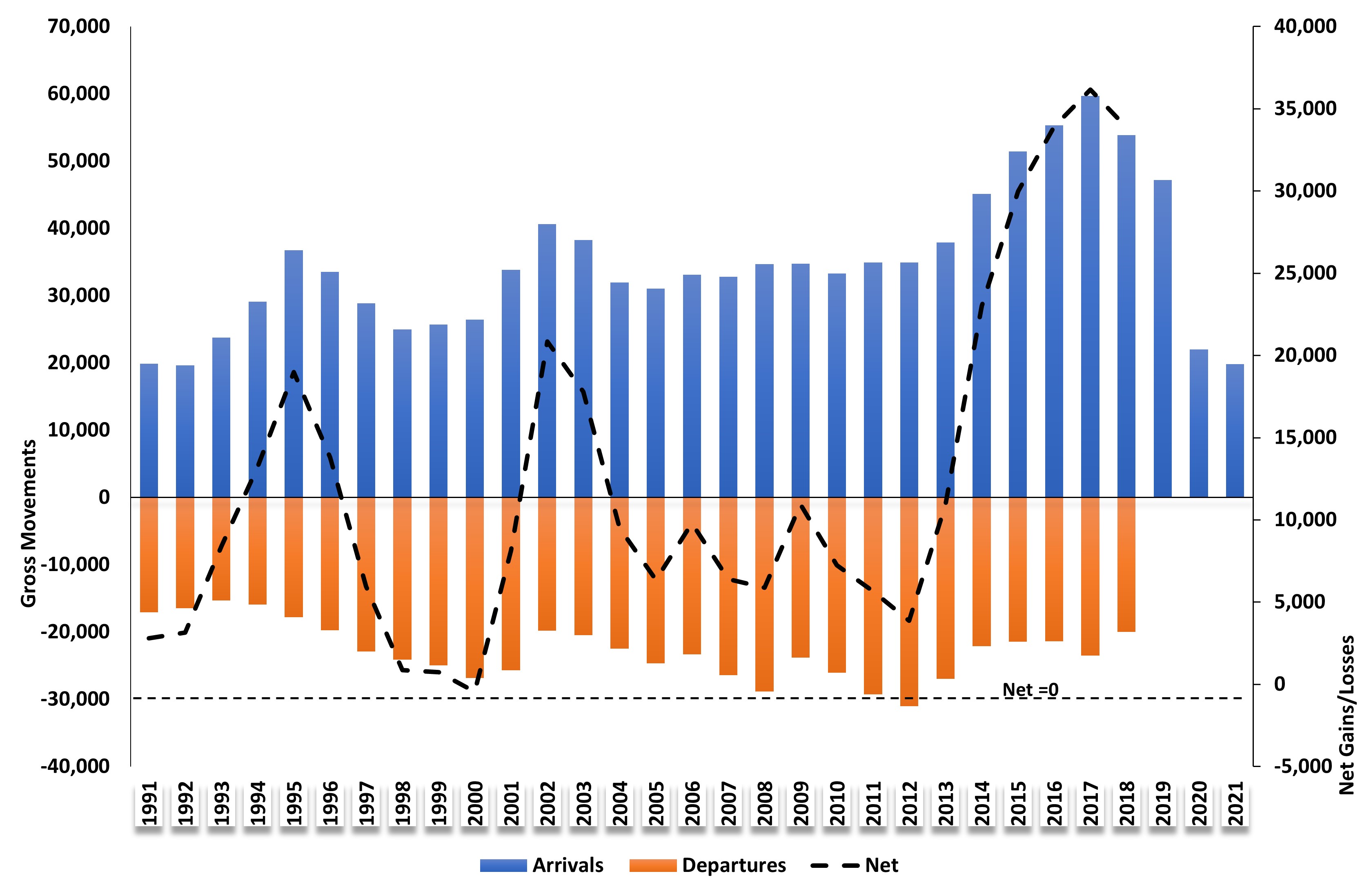
So, the planners had to bank on international migration to prop up their projections despite another fact: migration is cyclical (Figure 1).  The arrivals boom of the last decade was running down well before it was sunk by Covid.  Numbers peaked in 2017, then fell in 2018 and 2019, departures not so much.

Figure 1: New Zealand International Migration Movements 1991-2020


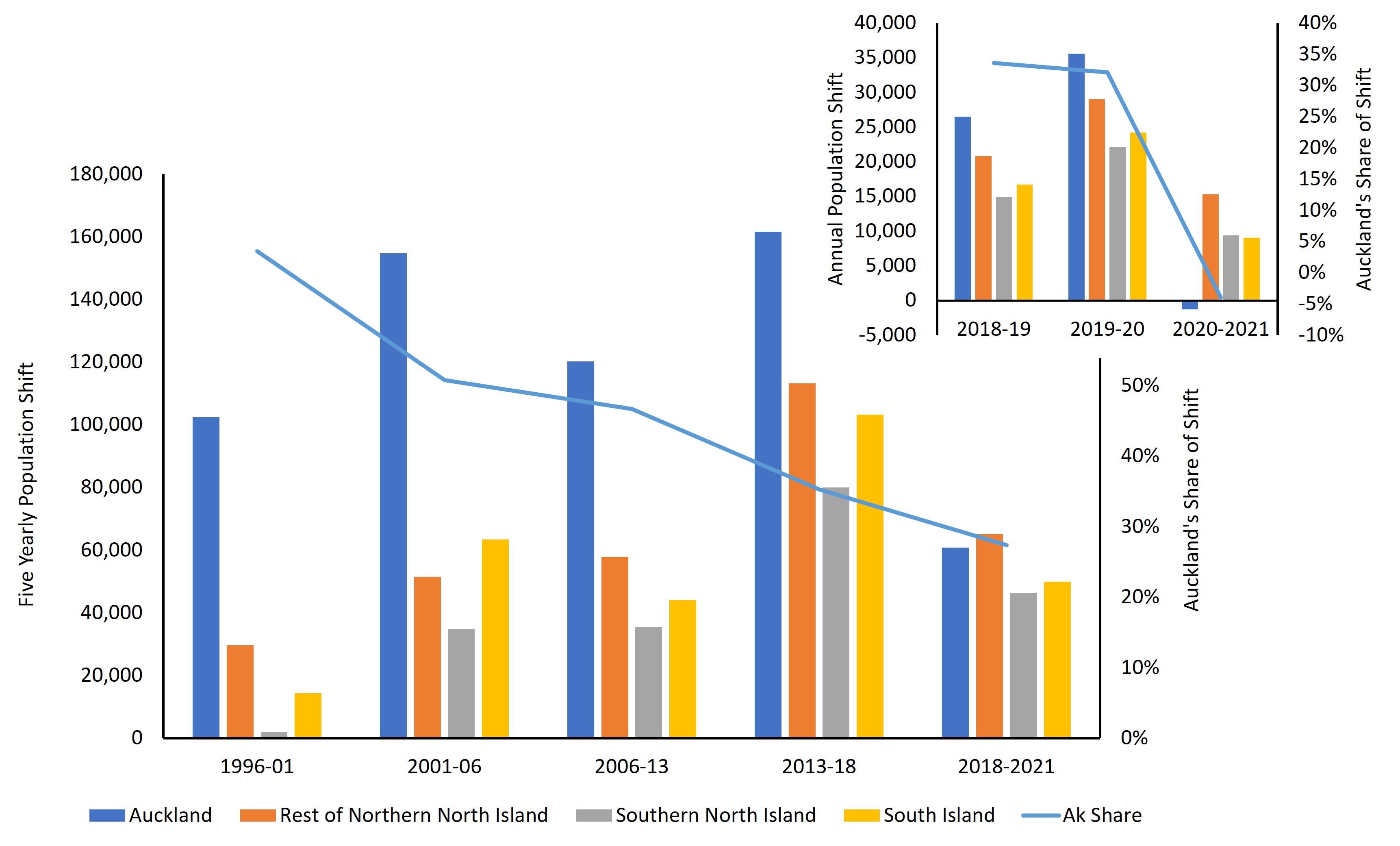
Another fact: Auckland’s much-touted dominance of national growth has been falling since 1996 (Figure 2). With Covid, it stalled completely, while the rest of the country grew. So much for the heroic planning extrapolation of continuous growth.  

Figure 2: Population gains, Auckland and the Rest of New Zealand, 1991-2021
 

This is not what we expected – or planned

It appears that the Council justified its plans and infrastructure spending on flawed expectations. Compare Auckland’s June 2021 population with two sets of Statistics NZ projections, for example (Figure 3).  The Council used the medium projection published in 2017 (based on the 2013 census) to inform its updated plan, Auckland 2050. Published in 2018, this projected 29% more growth to 2021 than actually occurred.

The next projections, published in 2021 using the 2018 Census, reduced the base figure, but still assume a medium migration gain of 12,000 a year to 2023[1]. This, already, looks unachievable.  

Figure 3: Projected and Actual Population Outcomes


What are the consequences? 

Promoting multi-unit infill housing when growth stalls raises the risk of a surplus of dwellings, particularly apartments and units. Are we looking at a housing glut?

Unders…

Between October 2014 and June 2018 Auckland Council issued 33,000 certificates of compliance for new dwellings. [2]  Yet, between 2013 and 2018, Auckland’s population grew by 161,000 people, the equivalent of 54,000 households at 3 persons per household. This suggests 21,000 too few houses built relative to population growth.

This shortfall may have led to a lift in household occupancy with more large multi-family, multi-generation and non-family households, and left more people homeless or living in institutions [3] which, incidentally, raises questions about the drive for more small dwellings. We certainly need to know more about social and demographic changes affecting housing demand before we can be confident that boosting multi-units indiscriminately across Auckland is the solution to the city's housing woes.

Overs …

Since then, measures taken to facilitate consenting have lifted construction. In the four years to December 2021 63,000 consents were issued, equivalent to around 60,000 completed dwellings. However, population growth of just 60,800 people over the four years to June 2021 would have generated demand only 21,000 new dwellings. This suggests a surplus of close to 40,000 new dwellings relative to population growth.

This is good news for new home seekers if it corrects an over-heated market, although it’s not clear that it resolves the need for well-founded and well-placed social housing.

While the figures here are estimates, the story they tell is compelling. The pendulum is swinging back, with the prospect that an emerging  housing surplus becomes a glut.  

Short-term supply constraints may defer that outcome. Yet, while house prices should fall, Auckland’s flawed growth strategy has already made life hard for young households, and less attractive for empty nesters. So, with borders reopening post-Covid, international departures may well exceed arrivals for several years. The population slump promises to be prolonged.

Stand by for a disrupted housing market

Over-supply is not good for the construction sector. Those with long memories know that a slump in housing demand packs a triple punch. It undermines many businesses committed to a key economic sector, with negative flow on effects. It slows household spending as equity falls, especially if interest rates rise. And it generates a flow of construction skills west, across the Tasman.

If the latest tranche of cookie cutter units proves too crowded and cramped, other skilled and motivated young households will be joining them. For those assigned unwillingly to “generation rent” higher wages and lower prices across the Tasman may still offer the best path to home ownership.

Where, then, will the new demand come from to pay for the council’s super-city commitments and aspirations?


[1]         The medium projection then provides for gains of 10,000 a year from 2023 to 2048.

[2]         This was completion rate of around 95% compared with consents issued in the previous   calendar year

[3]          Census data indicated an increase of only 20,100 households.

Thursday, April 20, 2017

Auckland facing Hobson’s Choice: Expansion or Implosion?


Choosing Auckland
In 1840, the first New Zealand Governor, William Hobson, sailed into Waitemata Harbour and chose Auckland as the country’s new capital.  The harbour offered ease of embarkation and disembarkation.  Fertile coastal lands meant that settlers could grow food crops, and the local Maori tribe, Ngati Whatua, welcomed the promise of protection and trade that European settlement offered.

Auckland’s early fortunes fluctuated.  The city could only be reached easily from other early settlements in New Zealand by sea .  It was on an isthmus divided by two harbours, crossed by flood-prone creeks and peppered with swamps.  In addition, tribes to the south resisted the sale and alienation of their fertile Waikato lands, stalling expansion of European settlement until the late 1860s. 

The emergence of New Zealand’s first city
Auckland survived, though, even when New Zealand’s administrative capital was moved to Wellington, 600km south, in 1865.  Rivers were bridged, wetlands drained, waterfronts reclaimed, and a railway pushed into the fertile and now subdued Waikato region, and beyond. 

The city prospered in the 20th Century, dominating the import and distribution of manufactured goods and exporting regional produce.  Consequently, it developed a substantial import-substitution manufacturing sector, boosted by protectionist policies introduced in the 1930s. 

When the economy was deregulated, starting in the late 1970s,  manufacturing’s role contracted.  However, its presence and the city’s trading heritage set Auckland up as the primary service centre in New Zealand, providing business, professional, trade, and financial services to production (much of it taking place beyond its boundaries), and catering to the needs of a steadily growing population.

Primacy in the 21st century
The cumulative advantages of scale served Auckland well.  Although still a small city globally (347th on the UN Population Division’s 2015 city size listing), it accounts for 32% of New Zealand’s population and 34% of its employment. This primacy reflects the importance of consolidating human skills and resources in a small country (population 4.8 million, less than the Sydney metropolitan area’s 5 million 2,000km across the Tasman Sea) and the low density of settlement over the rest of New Zealand.

Auckland remains New Zealand’s centre of disembarkation.  Even as increasing numbers of residents decamp for hinterland towns and smaller cities, New Zealanders returning from overseas, new migrants, and international students tend to make Auckland their first stop (Figure 1).  As a result, the city accounted for 50% of national population growth over the five years to 2016, a period of exceptional migration gains.


Figure 1: Net Long-Term Migration, Auckland and the Rest of New Zealand, 1991-2016

Reaching choke point?

Today Hobson’s site seems unsuited for a city of even 1.5million, let alone the 2+ million projected for the not-too-distant future.  Physical constraints have put the squeeze on housing and transport.  Ageing underground infrastructure struggles to cope.  The city may be approaching – or have already exceeded –Tamaki Makarau’s carrying capacity.  That, though, is not something that Auckland Council seems ready to contemplate.

Unfortunately, an obtuse planning response to the challenge of growth is set to squander the human and physical capital already invested in the city, and to mar its natural qualities.  A plan preoccupied with boosting employment and housing in a confined CBD and to promote increasingly intensive development on the Isthmus looks set to throttle growth. 

Externalities abounding
The outcome for Auckland of a strategy of consolidation and centralisation in is already apparent:

·         Under-capacity public and private transport services and a lack of redundancy in the networks lead to frequent stoppages on road and rail throughout the city, compounding already excessive congestion;

·         Restrictive land use policies create a hopeless backlog of housing demand with severe economic and social impacts (see, for example, the presentation of economic commentator Shamubeel Eaqub in Joel Cayford’s Reflections on Auckland Planning);

·         Increasing costs to business – the costs of employment, congestion, business disruption, and even space for growth raise the spectre of slowing investment, diminishing productivity, and income growth;

·         Grossly inflated land prices feed into high housing costs, distorting the supply chain and generating a new middle-underclass, defined more by frustrated housing aspirations than by educational or family shortcomings;

·         Failures in water, sewage, and stormwater systems threaten the health of the harbours and estuaries which give Auckland its character;

·         A growing likelihood that significant natural events (such as intense low pressure storms) will increasingly bring a congested city, its critical services, and its centre to a halt.

It’s the geography, Stupid
The response to the challenge of growth has been to promote increasing densities in the central city and, latterly, in the inner suburbs, a strategy that is deeply flawed for this city (something I have laboured in earlier postings: e.g., here and here). 

This strategy flies in the face of Auckland’s geography and the natural constraints it imposes.  It raises the prospect of fiscal failure for the council because it requires high cost works with limited if any productivity gains while compounding depreciation, maintenance, capital and servicing liabilities. 

The city will be hard placed to meet its financial commitments if the current crisis of growth accelerates, further lifting ratepayer costs and reducing the affordability of Auckland to business and households alike.  And any slowdown would only compound the city’s fiscal miseries.

Hobson’s choice
So now we are faced with our own Hobson’s choice (Thomas’ not William’s): the city has little option but to find ways to expand.  It is time to embrace new approaches to land and its use in the region, how and where it is developed, and how it is connected.

Given that Auckland Council seems hell-bent on promoting consolidation on a site ill-suited to it and in a culture in which it will work only for a few, this will only happen with a dramatic shift in thinking.  That might come if Government moves quickly to embrace the proposals for revamping urban planning through the rewrite of the Resource Management Act and shake up of the planning establishment proposed by the Productivity Commission The choices for Auckland are narrowing.

Tuesday, April 5, 2016

Auckland Planning: Doing Less with More

The burgeoning bureaucracy
In 2010 the eight Auckland councils were amalgamated into one.  I’m not sure why and my early prognosis gave the experiment five years before failing.  This was based on the unwieldy nature of the proposed council – multiple layers of management were bound to complicate and slow down decision-making and further remove policy-makers from the places and people for whom they are actually making policy.

More managers also means much higher wage costs, more internal meetings, and a reduced capacity to respond on the ground to the needs and wants of different communities and places. 

Talking, talking …
It was no surprise, then, to read the report in the Herald (4 April 2016) of 37 city managers attending a workshop on updating the Auckland Plan in February.  The manager of the strategic planning process for the Council justified this by saying that “input from different experts across the organisation and workshops are used as the most efficient and effective way to ensure expertise is shared across the organisation”. 

Talk about talking to ourselves!  And what have we got to show for it?

Well, most people are beginning to understand that the approach promoted in the Auckland Plan of using less land to absorb more development is pushing up prices for housing, costs for businesses, and congestion for commuters.  And these inevitable outcomes of rationing urban land can be compounded by inadequate infrastructure provision.

It’s certainly time for the council to have a rethink.  But I’m not holding my breath.  The last time planners recognised their plan for a compact city was not working, they simply argued for more regulation (in Growing Smarter, Auckland Regional Council 2007).

Getting grounded
The deficiencies of the current planning culture go further than the impacts of land rationing on property markets.   I’ve attended several hearings reviewing the Proposed Auckland Unitary Plan (the PAUP, a statutory document intended to implement the aforementioned Auckland Plan).  I’ve been struck by three things. 

(1) Private costs and commitments
First, there is the amount of time spent by the very large number of professionals drawn into the process: lawyers, independent planners, and a variety of experts (including the many consultant planners and experts commissioned by the council to advise its "different planners and experts" – go figure). 

The cost of all this to the wider community must be substantial – quite apart from the Council's $70m annual planning budget ($45 for every person living in the region).

(2) Getting grounded
Second, many private citizens are putting real time and thought into making submissions to a plan that has serious implications for them and their neighbours, their livelihoods and their lifestyles.  However, at the plan hearings in different parts of the region submitters addressing local, practical matters are up against by a centralised process and a complex and coercive set of regulations built in large part on supposition.

In fact, it is the many parties with a commitment to living and working in the region that anyone charged with thinking about the future of Auckland should be listening to, rather than talking to each other.  

Unfortunately, the groupthink taking place in Auckland Council excludes divergent views and local circumstances when they cut across the beliefs that mark the current planning culture.

Institutional myopia generally is one of the reasons we end up with dubious decisions by large organisations out of touch with their public. This has already been demonstrated in the Council’s faulty assessment of housing capacity behind the proposed Auckland Unitary Plan.

Hopefully, the Plan Review Panel will counter such narrow thinking and ground the PAUP in reality rather than theory.

(3) Push back
Third, council officers and consultants seem almost inevitably to push back against any deviation from the PAUP proposed by submitters, implying that the principles they have adopted should prevail over the knowledge, aspirations, and circumstances of households, businesses, and community groups. 

Even when council officers change their position in the face of the evidence, it seems often to be to draw back from increasing flexibility or providing for wider development opportunities, even to the extent of retreating from provisions set out in the PAUP as originally notified.  

This might be acceptable or understandable if we are confident that the Council has properly identified and prioritised the issues, objectives and policies in the first place.

House of cards?
Unfortunately, we can’t be.  Drilling down into some of the material cited in the hearings and the documented rationale for various objectives and policies in the PAUP (contained in Section 32 reports) is disquieting.  There is a plethora of material, it is difficult to access, not especially conclusive, and in many cases, hard to relate to the policies it purports to support. 

A lack of clarity or critical analysis means that much of this material appears irrelevant, dated, or contradictory.  This raises the uncomfortable thought that despite its budget, the quality of expertise bought to bear on planning in Auckland does not match the challenges associated with a region of 1.5 million people (and growing), compared with preparing plans that deal more directly with the circumstances of different areas within the region. 

Consolidating planning and plans (and truncating the process) with the aim of streamlining is beginning to look like a step in the wrong direction.

Or less charitably, it may indicate that the quality of our planning is not up to the challenges of reconciling sound environmental management with the diversity and volatility of modern urban development.  This has serious implications, including that of not providing for the housing and employment needs of a population that the planners expect to continue to grow strongly for the foreseeable future.

When is more too much?
All of this led me to revisit Auckland local government employment numbers.  I haven't dug up the numbers employed directly in planning.  But the overall Auckland figures increased 8.8% over the two years to 2015 compared with just 2.2% for the rest of New Zealand.

In fact, Auckland’s local government employment jumped by over 50% from 2010 to2015!  The rest of New Zealand experienced just 5% growth.  (This included 23% growth in Canterbury, a short-term boost attributable presumably to the response to the 2010 and 2011 earthquakes). So much for the greater efficiencies trumpeted for amalgamation.


Worringly, 50% growth in local government employment compares with an estimated 9% growth in population and less than 13% growth in other employment over the same period.  


In this case, more may be less
Auckland is clearly putting more resources into local government. It’s hard to see the benefits this is delivering to a city struggling still with expensive land, inadequate transport infrastructure, inappropriate land use, and an intrusive planning culture which appears to be promoting more rather than better regulation.

Friday, November 27, 2015

Planning to Fail - Wrong Assumptions, Wrong Policies


A Complex and Contested Plan

Deficiencies in the vision for a compact city promoted in the Auckland Plan are apparent in the contested nature of the statutory document intended to implement it.  The Proposed Auckland Unitary Plan (PAUP) has attracted 13,000 submissions and is subject to extensive hearings by an independent panel

The proposed Plan is complex and detailed.  It aims to manage the public domain and private behaviour mainly by regulating land use, defining in detail what can be done, how, and where. And because there will be winners and losers from applying its many rules, it is not surprising that many people are concerned at the content.

Where is the evaluation?
Given the direction underlying the Auckland Plan – a compact city focused on an intensively developed CBD and relying on a legacy of heavy rail and buses (and now, perhaps, trams) to alleviate congestion – the PAUP will inevitably impact on many people and organisations.  It is surprising, then, that the evaluation of policies did not deal with the distribution of costs and benefits. 

But then, the analysis, such as it is, is not very strong on costs and benefits at all.  Anyway, despite the long list of papers and reports assembled in support of the PAUP (the “Section 32 Report”), few appear relevant to or reflected in the land use policies adopted. 

The evaluation is focused, the S32 Report claims, on “the objectives and provisions within the proposed Auckland Unitary Plan that represent significant changes in approach from those within the current operative Auckland RMA policies and plans”.
The comparison of policy options required for evaluation appears to have relied on a bunch of like-minded people comparing four somewhat arbitrary scenarios of the future.  Curiously, all four scenarios are based on a single population projection as if how we plan has no impact on the outcomes!  That hardly matters, I guess.   I could see no recourse to any formal analysis of policies anyway, and no obvious attempt to distinguish the marginal differences among them that an evaluation of changes from “current operative policies and plans” would call for.
And what of the quality?

My concern about the quality of evaluation is heightened because the proposed Plan’s spatial policies are based on misleading analysis.  The fundamental assumption that the proposed plan needs to provide sufficient capacity for an additional 400,000 households over the next thirty or so years is demonstrably wrong.  

Having heard the level of disagreement among experts about the credibility of this number, the Hearings Panel back in April asked them to jointly produce an estimate that they could agree on. 

They couldn’t. Over several months of collaboration and analysis the best the group could come up with was an estimate of 83,420 “developable feasible” dwellings – or 26% of the Auckland Council’s Plan estimate (013 Expert Group, p5).[1] And despite acknowledging that this was much more realistic , the Group failed to reach a consensus on a final number. 

Which to my mind was just as well: to believe that we can predict both dwelling demand and supply without even seriously referencing the impact of price on demand (among other shortcomings) over 25 to 30 years is a conceit too far. The more we refine such projections, seek consensus, and treat the results as reality, the less we are prepared for the uncertainty that inevitably attends our plans, and the greater the risk that, in our ignorance, we adopt inappropriate policies.

So what happens when the policy makers get it wrong?  They keep going regardless

What is even more disturbing, though, is that the Council gives the appearance of cynically changing the Plan rules to offset its miscalculation. This has been done in haste, apparently, without reconsideration of the policies they support, without obvious analysis of the effects of these changes, and certainly no consultation with those affected.  Hence, the New Zealand Herald reported in September that by relaxing rules within the plan, council planners were able to get their capacity numbers over 150,000 (still a long way short of what the plan is supposed to deliver).  

To help achieve this, the heritage provisions of the Plan, always problematic, were effectively dumped in October. And in November, the Council’s Unitary Plan Committee accepted changes to the Single House Zone in central and western suburbs to Mixed Use to enable townhouses, studios and apartments to achieve the new number.

Now where did that come from?  I have searched the Council website for an analysis of the effects of these new policies and cannot find it.  At least the media is prepared to air the changes and their potential effects.

Dumping on the suburbs
The Plan certainly needs to address the future of Auckland’s suburbs: this has been a failing all along in a city which is no longer mono-centric and in which any expansion will be shaped by the simple fact that it is contained on a narrow isthmus.  But this sudden zone change is knee jerk reaction to what has been revealed as an ill-informed plan.  It has no apparent regard for matters of open space, transport and transit, commercial services, schools and other public services, or community and recreational amenities, all critical to the quality of suburban life. 

Simply creating new rules that can fundamentally change the character of suburbs because the planners got it wrong first time round without any obvious attempt to appraise or moderate adverse effects undermines the credibility of the proposed Plan, the process, the planners, and the politicians. And it’s cynical to the extent that it potentially circumvents the independent hearing process and suggests that the Plan is no more than an ad hoc means to an arbitrary end.

A step too far?
The uncritical foisting of a particular set of beliefs – that the way to the future is through less of what we have now -- raises fundamental questions over the practice of resource planning, not just in Auckland, either.  Whatever we call it -- urban design, place making, or resource management –an autocratic and patronising mind-set today permeates urban planning and is increasingly reflected in the diminishing capacity of elected councillors and board members to influence outcomes. [2]

Planning to fail
All this will make life that much harder for many Aucklanders to live here, especially those who do not already own a home.  While much is made of the City's growing diversity there is little evidence that the plan is sensitive to differences in places, communities, and circumstances, or that it is flexible regarding where and how different peoples might live. It looks set to sustain and even exacerbate the division between those who stand to benefit from property ownership and those to whom the Plan offers little hope of home ownership, and the social, health, schooling and employment benefits that brings. 

The proposed unitary plan looks set to accentuate divisions rather than accommodate diversity.

Time to think about connections and consequences
Unless there is a radical change in the way we plan, I see little prospect of sustaining the growth Auckland has recently experienced or of achieving the projections that the Plan is built on. For all its expertise, the Group convened by the Independent Panel failed to agree on what the Plan provides by way of capacity, or to forge the link between housing supply and demand .

A new approach is called for.  Let’s treat housing as a right, land for housing as a necessity, and prepare a plan that enables us to provide it in a cost effective and timely manner. 
The failure to provide land for sufficient dwellings so graphically illustrated in the Expert Group’s report (and in others[3]) must lead to a decline in demand as prices escalate.  We may have a liveable city on some measures if the PAUP is somehow implemented, but for whom and for how long?


[1]           Topic  013 Expert Group (July 2015) Residential Developable Capacity for Auckland Report to Auckland Unitary Plan Independent Hearing Panel
[2]           And unfortunately this is not about to be changed by the Government’s latest tinkering with the Resource Management Act,
[3]        Quite apart from the many submissions to this effect (see Hearings Topic 13 at the Independent Hearings Panel website), the Productivity Commission has published two compelling reports on this issue.

Monday, November 3, 2014

Credibility on the line: time to get real about Auckland transport and land use options

Councillors are getting nervous about the planned central rail link (CRL).  So they should be.  And while planning is well down the track, it’s not too late to apply the brakes.

This post strings together some of the arguments I have raised against the CRL over the past several years[1], and adds another one –the likelihood that technology gains will further undermine it.

But first some basics. 

Moving more and moving further
Transport is a derived demand: you only get it in response to the demand to move people or goods.  And as information flows more and more freely around the world, so growing demand for travel and trade -- locally, nationally, and internationally -- drives investment in transport. 

As nations, towns, and cities prosper, we travel more and further.  We exercise greater choice in where and how we live.  We consume a greater variety of products and services at lower prices.  And the transport sector responds with ever increasing products, services, and capacity.

Of course, it’s not just a one-way street. Transport innovations facilitate new trading relationships and expand travel demands.  Innovation-driven gains in mobility have enabled the masses and not simply the rich to enjoy the benefits of access to more space, more places, and more lifestyle opportunities. 

For example, the arrival of the wide-bodied jet in the 1960s and the more recent emergence of the single aisle, light weight, twin engine long-distance jet have increased the affordability of long distance travel and supported the emergence of many more international travel destinations for many more travellers. 

Similarly, the globalisation of production has been facilitated by transformation of the freight industry into an integrated transport, storage, and fulfilment logistics sector operating seamlessly to deliver lower priced goods from producer to consumer regardless of the distance and borders between them.

Urban transport – a history of increasing personal mobility
This is not the place to detail the history of urban transport, but it’s worth noting a legacy of occasional step changes resulting from disruptive new technologies interspersed with long periods of refining existing technologies.  These two have offered people the opportunity to enjoy more space, better health, and better lifestyles through progressively improved access to housing, services, work, and recreation. 
 
Hence the displacement of horse and carriage with steam-driven and tracked vehicles in the second half of the 19th century, the replacement of steam engines with internal combustion engines late in the 19th century; the introduction of the omnibus at the beginning of the 20th; the development of mass-production techniques for automobiles in the 1930s; and their proliferation in the 1950s and beyond.

Innovations in engines, propulsion, and materials have led to continuous automobile performance improvements. Even so, concerns about congestion, threats to oil supplies, pollution, and the costs of providing more road capacity raise questions over just how much more car use we can sustain. 

Despite its own gains in distribution, comfort, and speed, mass transit remains an alternative limited by fixed routes especially in today's complex and often fragmented cities.  The problem is less acute for buses than trains, although the economics of providing routes and schedules to suit diverse needs in large cities are entrenched in both modes.

So, where does the next step change lie in urban mobility?

Driving innovation
Perhaps the rate of advance to existing technologies has reached the point that disruptive technologies are less likely.  Ongoing innovation in car operations (built most recently on revolutions in information technology) and advances in engines are likely to deliver major capacity gains from infrastructure and lower the cost and impacts of private motoring[2], lifting personal mobility and reducing the likelihood of step change.  At the same time the propensity to use cars is stabilising, if not diminishing. [3] The threat is that the fixed route options for public transport will become even less attractive.

Of course demand will be  continue to be driven up by population growth, even if individuals drive less.  Herein lies the challenge: we are not talking about the mobility of current Aucklanders, but that of perhaps a million more seeking their share of transport infrastructure. 

How do we cater for this: promote a return to the old technology of fixed route rail capacity?  More roads? Or by managing transport demand through effective land use planning?  I prefer a combination of all three, but it’s a preference based on (1) understanding the particular limits to and costs of continued obsession with rail and particularly (in Auckland) the CRL, and (2) returning to an emphasis on sensible land use as the engine of this particular train, not transport.

The limits to rail
At the risk of being repetitive [4] here are some of the reasons to reject major expenditure on the CRL (or a rail-based airport link or harbour crossing for that matter):

(1)  Demand will be limited.  A doubling or tripling of rail patronage will not go far in terms of total commuter demand given the very small base it operates off; 9,000 Aucklanders commuted by train according to the 2013 Census.  That's 2% of commuters.  Currently 10% of Aucklanders commute by public transport, 80% of those bus.
 
Boosting public transport demand though park and ride facilities or integrated ticketing is limited by the relatively small number of destinations served.  Public transport travel time costs are already high and multi-mode travel inevitably lifts them no matter high efficient. 

Boosting public transport demand by providing inner city dwelling capacity is largely irrelevant as inner city commuters already have a high propensity to walk, cycle or take public transport to work (only 55% use a private vehicle).  That market is tiny anyway, and likely to remain so.[5]  

Promoting high density dwelling around stations at key suburban centres to boost train patronage will meet market resistance.  And, if successful, it will lead to conflicts between local activity and park and ride facilities, adding to local congestion. 

Focusing employment on the CBD to boost the use of public transport ignores the needs of the majority of businesses (only 12% of Auckland employment is currently in the CBD).  It also ignores questions over the resilience of the CBD. its ageing, often capacity-constrained infrastructure. and the vulnerability to extreme climatic events of low lying and reclaimed land on which much of it is built[6].

Promoting higher employment densities around stations to lift the viability of rail will generate additional road congestion as much of the interaction around businesses still requires point-to-point vehicle access, the majority of commuters are likely to remain car-bound, and the more people that live in and around the CBD the more of them will need to commute outwards to employment as well as for recreational reasons -- by car.

And there is a real question mark over what those many more white collar workers in the new towers might be doing,[7] especially as high tech employment increasingly favours low rise, green working environments.

(2)  The impact on congestion will be minimal. Creating additional road capacity by diverting some commuter trips to public transport reduces the costs of private transport, encouraging greater car use until such time as unacceptable levels of delay once more set in.  Such evidence as there is for developed cities in North America, Australasia and Europe does not support the proposition that public transport reduces congestion.[8]

(3)  The Capital costs will be high – almost inevitably higher by hundreds of millions of dollars than current estimates;[9].  Even without the usual "large project blowout" the marginal costs will be very high: if the impact was to triple daily commuting patronage to, say, 30,000 people a day a capital cost of $2.4bn (both optimistic assumptions) represents $120,000 for each additional commuter.
 
(4)  Overheads will be high – fixed costs are a large component of rail overheads.  These include operating costs, maintenance, and renewals (for rolling stock in particular), interest on capital, and depreciation.  Any demands on ratepayers or road users to subsidise this are still costs, costs that are likely to reduce the attractiveness of Auckland as a place to live or invest. 

In addition, pricing public transport to recover even a constant share of higher costs from users is likely to lower demand. This, in turn, is likely to reduce income more than costs, potentially leading to a subsidy (public cost) blow out.

(5)  The business case relies on heroic assumptions about the future of work and housing.  Building a case on assumptions about a shift to high density housing on suburban stations and new towers of white collar employees around inner city stations is highly risky, with no evidence that the risks have been factored into decision making. [10]  And there seems to be little consideration given to the risks to rail resulting from technical advances taking place in the automobile industry that should increase the efficiency of roads, lower the costs and boost further the convenience of cars, and improve the performance of buses  [2],

(6)  The economics do not stack up and consequently fiscal risk is high.[11][12]  The legacy of the CRL is likely to be enduring debt and costs that potentially reduce the appeal of Auckland as a place to live without reducing the problem of congestion. And they will be so much higher if the optimistic projections on which the business case is based fail to materialise.  When costs substantially exceed benefits productivity suffer and the Auckland economy is the loser. 

There’s got to be a Better Way
The aim of this post was to contribute to the current debate over the future of the CRL.  Whether or not it goes ahead it is not going to solve Auckland’s transport problems.  Nor will an integrated transport system based on common ticketing and interchange stations with their substantial land demands and impact on local and arterial road congestion help much.

The long-term solution may best be based on a return to basics: identifying the land use pattern that is in accord with both the city’s geography and the ambitions of the council to house another million residents (an ambition that seems to have gone un-debated in the lead up to current plans).  The transport system needs to be organised to serve that. 

Planning land use to serve an outmoded transit model based on an increasingly dated transport mode justified by the view that Auckland can continue to grow as mono-centric city is a recipe for disappointment  - and not just in transport.


[1] Starting on this blog with Buses or Bust? April 2011 and Rethink the Link: Does Auckland Really Need to Pour Money into a Hole in the Ground, December 2011  To get an alternative point of view, visit transportblog.co.nz/
[7] See, for example, Whither White Collar Services? December 2011
[11] This is the sort of contingency that a Business case should address as a matter of course.