Showing posts with label local democracy. Show all posts

Monday, November 26, 2018

Amalgamation and Streamlining City Governance: the Auckland Experiment So Far

The performance of the Super City – so far, so so
Previous posts indicate that amalgamating local government in Auckland has not yielded efficiencies. Catch-up spending may account for some of the costs, which have run well ahead of population growth, and the consolidated Council may be doing more things than its predecessors.
However, a failure to deliver on expectations suggests that performance is still a problem. This blog looks at the governance structures underpinning Auckland Council’s decision-making, concluding that amalgamation has simply changed governance problems, not resolved them.

Governance: councillors acting with authority
Authority for governing locally comes from the democratic process. Elected politicians are expected to represent the preferences of constituents in decision-making (which does not reduce the imperative to act within the law, consider sound technical advice, and evaluate the costs, benefits, and risks of alternative courses of action).
Implementing decisions falls to a chief executive appointed by and accountable to the Council. The CEO in turn appoints subordinate managers to implement policies. While the executive team is also required to advise on the decisions the Council takes, staff are not the Council. The Council is an elected body that ultimately speaks and acts collectively.[1]
Boards and managers
Council and staff roles have a parallel in corporate boards of directors and company executives.  Despite different conventions, similar principles apply. For example:
·        Effective engagement is required between council and constituents so that decisions take account of residents’ and ratepayers’ interests;

·        Accountability comes from clarity and openness so that the grounds, costs, and expected outcomes of decisions can be understood by constituents;

·        Clarity of communication and accountability between Mayor and CEO is critical to turning policy decisions into executive actions.
How many around the table?
The effectiveness of governing bodies in the private, not-for-profit, and public organisations is influenced by the size of the governance group. While this is a matter of ongoing professional and academic debate and  deliberation, it is generally agreed that 10 members should be sufficient to bring the necessary breadth of views and skills to the table while avoiding the distractions associated with larger boards.  Councils may have more than ten members, however, or use outside advisors to ensure that the full range of community views are brought to individual issues.[2]
Managing complexity: committees and council-controlled organisations
Councils work in diverse task environments. Traditionally complexity is managed through specialised committees reporting to the full council, which makes decisions based on their recommendations.
Using Council Controlled Organisations to deliver selected public goods and services is another way to deal with complexity. CCOs are governed by appointees, often with business experience, rather than elected representatives.  While operating to a charter framed by the council, they can act outside the confines of the public service.
Auckland’s CCOs – a mixed blessing?
An earlier post suggested that higher costs may be associated with Auckland Council’s reliance on CCOs. Table 1 lists them, including statements of purpose (from annual reports). These indicate changing roles, raising questions around mission creep and how and why council-mandated charters may be altered. 
For example, ATEED positions itself as multi-functional, moving closer to the Council’s environmental management and infrastructure responsibilities, while committing to a whole-of-labour market quality focus.
The Auckland Transport statement suggests a shift from supporting changing land use through transport investment and public transport operations to urban planning (“shaping Auckland”) and shaping transport behaviour.

Table 1: Auckland City’s Council Controlled Organisations
Tails wagging the dog?
It may be inevitable that CCO roles evolve as demographic and economic conditions change. It is also important that those changes reflect rather than lead council policy. (However, CCO directors and officers do have a role to play in advising the Council in their respective areas of expertise.)


Auckland City is now running into hard questions over the CCO model. In the spotlight at the moment, for example,  is the Regional Facilities Agency and the initiatives it is pursuing to “rationalise” long-established sporting venues
Another example is the failure of Panuku Development to align development planning with council plans.  It’s also problematic when a subsidiary pursues commercial objectives contrary to the wishes of the community, as when Ports of Auckland published expansion plans into the Waitemata Harbour. Similarly,  the subsidiary’s “out-of-scope” commercially-founded plans for a hotel and car park clash with Council’s plans for the waterfront.
Issues of autonomy, accountability, and conflict can reduce the value of CCOs and subsidiaries as they are directed by boards a step removed from democratic responsibilities and managed by executives not directly accountable to the Auckland Council CEO.
Local boards: compensating for a reduction in representation?
Local democracy depends on local representation. Amalgamation was in large part about reducing the number of councillors, from around 117 across eight councils in 2009 to 21 today (Table 2). This saw one council member for every 14,500 people in 2009 fall to one for every 64,600 in 2018, a 78% reduction in representation.
There was a slight increase in local board members (25% up compared with community boards in 2009), but given boards' limited responsiblities, the overall reduction in representation and consolidation of regional rather than local governance suggests a significant decline in democratic accountability. The increase in appointed directors of regional-scale CCOs[3] can be seen as contributing further to  the centralisation of decision-making.
Table 2: Local Government Representation, Auckland 209 and 2018

Insofar as participation in elections reflects it, consolidating Auckland did little for elector engagement. Residential turnout for council elections in 2016 was 38%, exactly the same as in 2007.

Local Boards, Local Representation?
It is unlikely that the powers delegated to local boards are sufficient to offset the loss of representation. Although the numbers of elected members of the individual boards lie within a reasonable range for organisational effectiveness (Figure 2, below), the spread of representation (defined as residents per councillor) varies substantially among them, well above the +/- 10% considered appropriate for electoral equity. 
Putting aside the exceptions of Waiheke and Great Barrier islands with their small populations, the highest level of representation is 7,400 persons per board member, well ahead of the lowest at 17,000 (the average being 10,800).
Figure 1: Representation on Local Boards 
And the Council?
Given its size, Auckland Council has the potential to be compromised by unwieldy numbers and the cross-currents and mixed agendas that attend a crowded governance table. The committee structure is unlikely to offset this because, in a rather strange arangement, all councillors are members of the three main committees (Table 3).  Over-sizing committees reduces the advantages of having small groups specialise in key areas before deliberation on policy options by the full Council.
Table 3: Auckland Council Committees
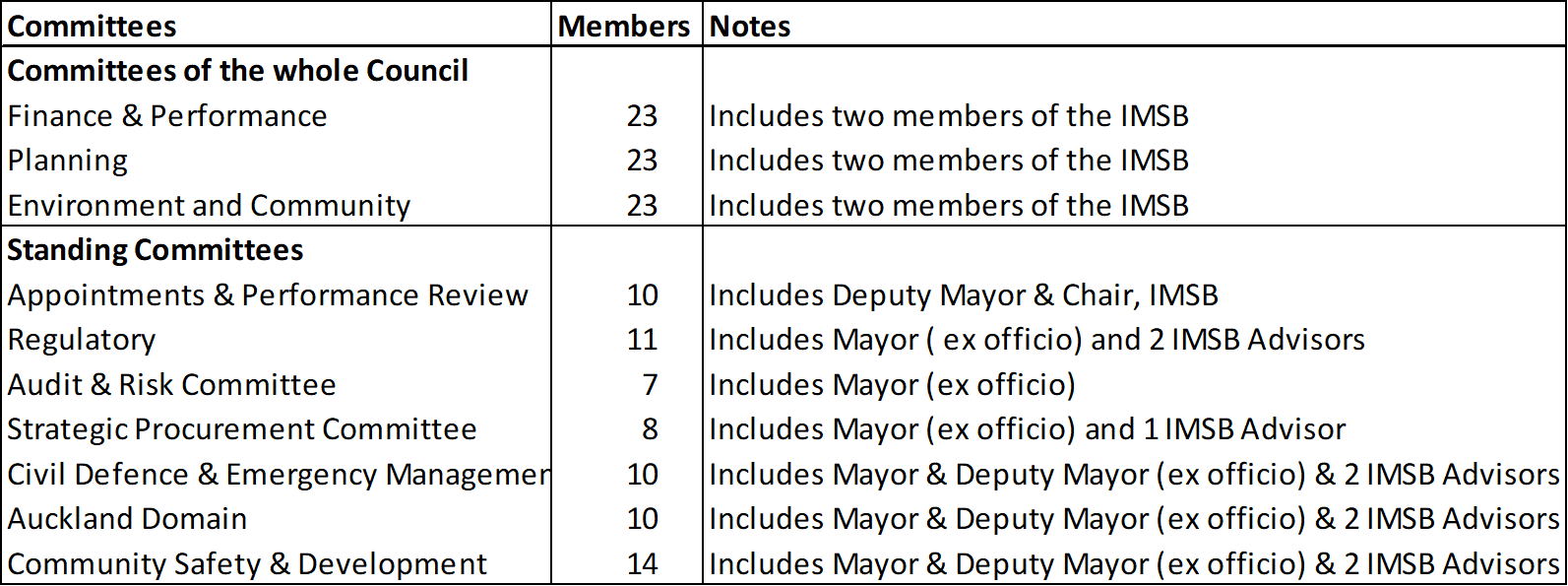
     IMSB: Independent Māori Statutory Committee

Time to review Auckland’s governance arrangements?
The outline of governance here suggests that the Auckland Council has the potential for cumbersome decision-making despite any streamlining intended from consolidation of powers.
For example:
·        The Council operates in a top-heavy manner, if only because its key decision-making functions are subject to deliberation by committees of 22;
·        The relationships among the governors (councillors, CCO directors and board members) and managers are potentially complex and communications constrained across boundaries;
·        Representation within the council is based on low elector turnout, while representation across local boards is uneven.
Given the evidence of rapidly rising costs in Auckland Council’s first eight years, the picture of consolidated power at the centre without obvious democracy, decision-making, or performance benefits suggests that it is time to again review Auckland’s governance arrangements.


[1]            Note to reporters: it is important for clarity to use a singular verb when reporting on the Council. The Council are not to blame for getting it right or wrong: the Council is.
[2]           The Independent Māori  Statutory Board pays an important role in this respect in Auckland.
[3]            The Royal Commission on Auckland Governance (2009) claimed “over 40” CCOs associated with local councils in 2009 (Final report, p.13). This implies a trade-off through amalgamation between many small organisations operating locally and a few large ones operating regionally.

Wednesday, February 8, 2012

Terms of Engagement: councils and their communities

Failures of local governance – the case of Canterbury
Christchurch City and Canterbury Region have suffered not just blows of nature.  They have also been suffering ruptures of governance. 
Recent protests against the Christchurch City Council, the appointment of a “minder” to oversee its activities, the establishments of the Canterbury Earthquake Recovery Authority by government to take over reconstruction of the city, and before that replacement of elected regional councillors by government-appointed commissioners all raise questions over the effectiveness of democratic governance.  
In the case of the city, the problem has been a seeming inability to respond effectively to the difficult but urgent issues of recovery and rebuilding after the earthquakes.  In the case of the region, the problem lay in an apparent inability to resolve contentious water resource management issues. 
Bigger as better: restructuring Auckland
An assumption of inadequate governance was also the cornerstone of the inquiry by a Royal Commission into how Auckland might better play a role as the economic driver of the nation.  The assumption was made that amalgamation - a structural response - would deliver governance and management improvements.
The  hoped-for administrative or technical efficiency gains pale against the prospect of better – or worse – decisions as a result of collapsing eight councils into one.  How much money might be saved on computer systems, for example, or consolidating staff is largely irrelevant if the quality of decisions about where, why and how public resources are allocated does not improve.
And it’s the quality of the big decisions that lies at the heart of good governance.  This underpins the significance of Auckland's proposed spatial plan (and why I am so worried about it).
Governance and democracy
Governance refers to the capacity to make decisions on behalf of an organisation.   The Oxford English Dictionary gets to the nub: governance is “ruling with authority”.  In democratic institutions that authority is conferred on their representatives by the citizens.   
Things go wrong when the governors forget that they are there to make decisions in the interests of the entire polity (or company, NGO, or agency in the case of corporate governance).  They are not there to push a particular viewpoint on the assumption that they know best because they got the most votes. 
That’s especially so in local government where multiple candidates and low voter turnout mean people frequently get elected by small numbers.  Despite the undue influence of minorities on electoral results, the mandate to govern locally still reflects a responsibility to act beyond the interests of any particular group. 
The alternatives – (1) governing by decree
Contrast this with dictatorships or monarchies, where authority to govern lies in military and subversive powers or arcane traditions, with governance typically benefiting only narrowly defined groups and unconstrained by popular accountabiity.
If elected politicians do privilege particular interest groups the quality of decisions is undermined (by a failure to reflect on all the options) along with the legitimacy of their authority.  (There may, of course, be a place in a constitution for regard to be had to the claims of particular groups.  In New Zealand the Treaty of Waitangi plays this role for Maori).
The alternatives – (2) governing by expertise
Good decision-making may be informed by the deliberations of experts.  But allowing technicians to prevail across decision-making is also the way of autocracy, dictatorship by another name.  The cult of the expert ultimately limits individual freedoms.  This appears to be a path that Italy and Greece have adopted after years of apparently deficient democratic governance, but it is a response to crisis, and unlikely to endure. 
In the long run playing to technical expertise to legitimate decisions contrary to community preferences limits democracy.  And it won't lead to good outcomes when implementation encounters community resistance.
The importance of transparency
Communities are hardly homogeneous.  Diversity and division, competition and complexity are attributes of society underplayed in both text books and rule books.  Resource allocation decisions almost invariably favour some groups over others.  That's why transparency is critical to good governance.  Understanding why decisions are made is a big step on the path to accepting their consequences.
People have the right to know the grounds on which decisions likely to affect claims on and access to public resources are made.  More than that they have the right to (seek to) influence them.  That’s where the terms of engagement between governors and governed come into play. 
Beyond the ballot box
There has been plenty written about how councils might engage with their communities.  I want to promote three principles here:
(1)    Engagement can take many forms, each with advantages and disadvantages.  Good engagement will draw across the full range.  Beyond the ballot box it is important not to be captured by any particular programme of consultation.  Politicians can engage with constituents informally and formally on a daily basis and in a number of ways.  Surveys and submissions, protests and petitions all play their part. 
(2)    Smaller structures are likely to be more open to engagement than large structures.  Fewer tiers of management mean that messages about delivery and performance, the feedback needed to inform decisions, have a better chance of getting onto the political agenda.  And smaller councils lift the presence and accessibility of decision-makers generally, keeping the channels open and boosting accountability.
(3)    Decentralised structures are likely to enhance engagement because they tap directly into the diversity of the community. 
Moderation by management
Information from the community is varied in content and credibility, especially in the age of the internet but, allowing for the occasional “idiot factor”, it cannot be taken lightly.  This is where council management has a role to play.  Too much or conflicting information just becomes noise, making it easy for politicians to shut it out and leading to decisions based on partial information at best and preconceived views at worst.  Or else they end up caught up in conflicting information currents, and go nowhere.
Management may moderate (not mediate) the flow of information to the governors.  So managers also need to be close to the community (another argument for moderation in the size of councils).  Their role is not to shape the information councillors receive, but to relate it to the issues at hand and, where necessary, to the interests of the wider community.
Community rules
There is clearly more to making the big decisions than simply listening to the community.  There are financial, managerial, and institutional limits on what councils can do.  And the views of experts about what’s possible and what’s feasible do need to be considered.  But management constraints and expert opinion are just two of the three legs of the decision-making stool.  Community engagement is the third. 
And as councils are beginning to discover, councils that become remote from their communities are on a hiding to nowhere.   Engagement is not just about going through the motions of listening.  If citizens are not heard even apparently logical decisions will come undone and, eventually, councils will come undone with them.

Tuesday, October 26, 2010

Whither local democracy?

Central Government Retains its Hold
The Minister of Local Government is reported in the New Zealand Herald to be considering establishing a committee of Cabinet with the power to make decisions over Auckland matters.  This echoes a suggestion by the Royal Commission on Auckland Governance.  It emerges though at this last minute as yet another in a series of convoluted arrangements made in response to the contested decision-making that has been a feature of local governance Auckland.
The reason for this proposal is that the new Auckland Council will have to deal with a large range of government departments.  But so does every other council.  Perhaps the real problem is that the new arrangements reveal the fragmentation of central government.  If so, why the special treatment for Auckland?  While it is by far the biggest local council that government has to deal with, that does not mean that Auckland’s problems are necessarily more complex than those of councils elsewhere.  In fact, consolidation into a unitary council was meant to have strengthened local capacity to deal with any issues that might be holding back the region’s development.
Coupled with the way in which the Minister has stage-managed the implementation of reform, from the time he issued a brief government response – Making Auckland Greaterusurping the Commission’s tome, through the appointment of the transition agency and the local government commissioner, to the three Acts of Parliament defining the structure of the new council, this reform has been driven from Wellington.  Appointments to the boards of the Council Controlled Organisations responsible for infrastructure and network services were also made by the Minister.  And now it has been announced that both the Minister and Prime Minister are addressing the inaugural meeting of the new council, something that journalist Brian Rudman suggests is “intimidating”.
Wellington in Auckland
Certainly, scale means Auckland’s economic performance makes it a focus of government attention.  But this was addressed in 2005 by the establishment of the Government Urban and Economic Development Office (GUEDO).  This included personnel from the Ministries of Economic Development, Transport, Environment, and the Department of Labour (DOL) “to achieve greater alignment of Government priorities and effort towards sustainable urban and economic development of the Auckland region”. 
The office joined the frenzy of reporting and caucusing about Auckland’s economic development, working closely with the Auckland Regional Council on a series of projects aimed at defining the “Auckland problem” and finding ways of resolving it. The results are not yet obvious as the region has continued to underperform the rest of the country in terms of employment growth, most evident in a 3.6% contraction between February 2008 and February 2009, compared with 2.3% for the rest of the country.
In 2010, joining the spirit of reform that took over the region, GUEDO changed its name to the Auckland Policy Office to reflect a “broader role in developing and implementing government policy in Auckland”.  Today central government’s Auckland Policy Office incorporates the Departments of Internal Affairs, the Prime Minister and Cabinet, Building and Housing, Treasury, the State Services Commission, the Ministries of Social Development and Culture and Heritage, the Securities Commission and the Environmental Protection Agency. Only a minority of these departments have staff in the Auckland office.  However, the APO is overseen by a committee of the departmental chief executives, suggesting that there should already be an appreciation in Wellington of Auckland issues and coordinated departmental positions on how to respond to Auckland initiatives.  What more do we need?
Another sign of Wellington’s growing presence in Auckland is the growth in central government administration in the region, with the numbers up by 60% over the past decade, to 6,100 compared with 4,710 in local government. (These figures do not include employees within operative services, including hospitals, schools, or water supply).  Even the central government bureaucracy in Wellington did not grow at such a rate, although it still managed to expand employment by 47% over a decade in which the capital’s total employment only grew by 17%.
Structural Change and Contested Decision-Making
One thread behind the creation of one council was the difficulty in getting agreement on major infrastructure projects – the region’s debate over and consequent rejection of the central government’s proposal to turn a large area of the waterfront into a rugby stadium being the obvious example.  Yet even after reform it seems that Auckland’s capacity to make its own decisions will still ride heavily on central government advice, agenda, and approval.  
But by raising the contestability of regional decisions to the national level, is there any guarantee of better outcomes for Auckland and Aucklanders?
Delivering on a Community Mandate
At least the “almost-local” ward electoral system and the creation of local boards in the new arrangement has created an opportunity for communities to be heard, and for this concession we should be grateful.  As it is, the representative system first time around was not to be denied, with a community-grounded platform prevailing in the mayoral election.  It remains to be seen how far the Mayor, Len Brown, can marry a community mandate with a structure in which economic rationality was intended to prevail.  And how far central government will support this, the local electorates’ preference, remains an unknown.
So in Auckland how far the representative system will deliver local democracy depends, still, on the leaning of a minority (if popular) mayor, and on central government designs.  Commentators watch with anticipation the capacity of our new mayor and council to deliver, and to deliver quickly, if they are to survive the next election. There is not much new in this.  It is how electoral politics works.
However, for local democracy to be truly and consistently served, it may be that the best form of governance comes from empowering communities to assist with decisions and, even more, perhaps, to deliver them. With the removal of physical infrastructure services and economic initiative to CCOs, the time might be ripe for a community development mandate to be addressed.  This can be done as much through developing the capacity of communities to implement what they want and not simply to define it. 
The issue may not be so much of what can we give communities, Mr Mayor, but how can we help our communities to serve themselves? This is a long way from the model imposed from the centre, but not beyond the reach of a new Auckland.  It is the way to true local democracy which perhaps, just perhaps, the new arrangements have opened up.  The alternative is to be looking always over our shoulder at central government.

Monday, October 4, 2010

Why aren’t we voting?

Are voters indifferent to the new Auckland?
My colleague, Richard Dunbar of Nexus Planning and Research and CityScope Consultants was asked by TVNZ News why the election for the new Auckland City Council does not appear to be attracting the voters.  Among other things he mentioned a protracted and drawn out postal voting system.  This reduces the urgency to vote and therefore its significance in the minds of voters.  Putting it off until it is just too late or seems unimportant is consistent with his experience of community surveys generally.
The voting papers were not particularly helpful, with pages of pen pictures devoted to a string of mayoral candidates, local ward and board aspirants, and district health board contenders.  (The last-mentioned attracts a large number of aspirants, many having moved on -- or having been moved on -- from council positions.  It provides for the nonsense of allowing electors to rank more than 30 candidates in a preferential voting process, something somewhat beyond the normal powers of cognition and computation!)
Richard also talked about the apparent lack of relevance of local government in people’s minds.  This isn’t helped if, as he observed, there is no apparent desire to actually share power with communities and actively involve them in decision-making. 
Nevertheless, the apparent failure so far of radical reform to engage voters surprised even the normally unflappable Richard.  The creation of a new single city has had plenty of publicity, emotions have run high, and the election itself has been well publicised.  The key mayoral candidates have had a lot of exposure.  This is important because one of the key thrusts of the reforms was to create a stronger mayoral office to ensure that Auckland gets strong and focused leadership.
Yet, on 4th October the New Zealand Herald reported that less than 25% of eligible electors had voted with just three days left for postal voting.  This compares with a reported 37% turnout across the region in the last elections (2007).
So what are the consequences?
This is not business as usual.  In terms of expectations for a Super City it’s a bit of a disaster.  The aim was to create strong leadership that would directly represent the region as a whole.  If only 35% to 40% of eligible electors vote, who might the Council be said to represent? 
And if the mayoral vote is split by a close election or simply because too many also-rans attract votes, we face the prospect of a “strong” Mayor enjoying less than 20% elector support!  How seriously will he be taken in Wellington (or anywhere else) under those circumstances?
Perhaps the reformists missed a trick by not thinking through the electoral implications of what they were doing, and what effect this might have on the integrity of representation in the new council.  It may be time to review what exactly we mean by local democracy in New Zealand, and how it might be achieved.  This is something to return to in future postings.
In the meantime, here are some more thoughts on why the turnout is looking so weak.
1.       Nothing has changed
·         Voluntary local body elections generally have a low turnout.  This is true in most countries where local government is seen to be weak relative to central government.  Compulsory voting might help, but what do the results mean if people remain disengaged?
·         In New Zealand Sir Brian Elwood, architect of the 1989 local government reforms, tackled this problem by emphasising the importance of the opportunity to vote, whether or not it is exercised.  Certainly relative to non-democracies this makes sense.  But the world has moved on since then, looking at ways of giving citizens a voice and promoting active local democracy. In the meantime, local government in New Zealand remains a bit of a yawn – or maybe a mystery -- for many people.
2.       Bigger is not necessarily better
·         A quick review of 2007 local body elections statistics confirms that larger councils tend to have lower turnouts.  For example, the Auckland figure cited by the Herald, 37% turnout, compares with a 49% average nationally in 2007.  The sense of disempowerment seems to grow as the numbers get bigger and representation (electors per councillor) reduces.
·      This is true of mayoral as well as councillor elections.  This evidence should have had the reformers looking at the options.  If a larger council is going to deliver the hoped for efficiencies, then how did they hope to marry these up with democracy, other than by fiddling with ward representation?  In fact, by creating a double structure of local boards and ward-based voting for councillors, they may have added to electoral confusion rather than compensating for the disempowerment voters experience when dealing with larger units of local government.
3.       So why aren’t we voting this time round?
·         In any case the agenda has been driven by the media to a large extent, defining broad regional issues that may not relate to individual electors' circumstances or  interests.  Through the practice of asking each candidate the same "big" questions and each, consequently, trying to cover his bases, rather than enunciating a distinctive policy platform, the result has been a focus on matters seem somewhat remote. 
·         The press (particularly the New Zealand Herald) has gone further by setting out its expectations of a single city in terms of the agenda of a range of business-oriented groups: it has effectively played the role of cheer leader.  Both these positions – lectern campaigns and media as cheer leader – diminish the potential differences and choices in the mind of the electorate.  
·         We have watched the Auckland Transition Agency implementing what seems to be a central mandate.  Whether or not the impression is fair, the main decisions appear to be made by central government.  In the public mind the key figure shaping this council is Minister of local Government, Rodney Hide.  Centralisation of power both in the structure of the new council and how it was put together quite possibly undermines voter enthusiasm.
·        Not unreasonably a lot of media attention has been on industrial issues: appointments, roles, redundancies, and so forth.  Press releases from the Auckland Transition Agency give the impression that several small bureaucracies are about to be replaced by one large one and some rather remote council controlled organisations. This is unlikely to grab the public imagination.
The single city process to date has probably reduced the sense of empowerment among the voters, the notion that "my vote will make a difference", simply offering more of what went before, writ large. 
What happens next time round?
Perhaps I should leave the last word to Richard.  He suspects that the first term will be one of turmoil.  The new council will be on a hiding to nowhere, trying to put the pieces together, to present a unified face, and fulfil expectations for civic and, particularly, economic leadership.  
He also notes that the election is just one opportunity for citizen  participation.  Perhaps if those who are elected recognise their tenuous hold on power and really do try to share the decision making with the community, there will be less chance of a major upheaval next time.  
What might be most interesting is what impact this situation will have on the next election.  Will this first term of the new council complete electors’ disillusionment or will it galvanise them into action?  And, either way, will this mean the end or the beginning of the single city? [1]


[1]               For some clues see the Canadian experience, summarised at http://www.rmastudies.org.nz/centre-digest/34-centre-digest/472-digest-making-auckland-work