Showing posts with label Auckland. Show all posts

Thursday, June 9, 2022

Auckland at a Turning Point 2: Marking Down the Labour Market

 Reality Bites

For some years I have been calling out the over-exuberant growth expectations behind Auckland’s planning.  I have also argued that creating a single council to pursue a compact city strategy was wrong.  First, the supercity structure was always going to increase the cost of local government while diminishing its responsiveness to the increasing diversity of communities and changing external conditions.  Second, planning based on intensification and centralisation was always going to frustrate the growth it was meant to accommodate, pumping up house prices, business costs, and congestion. 

These were hardly popular views, and it gives me no pleasure to say today that the chickens have come home to roost. Emigration is rising. Housing demand is softening, although too late to prevent a growing division between expanded renter and shrunken owner classes. The need for social housing is well up, while the already high cost of home building keeps getting higher. (And through grandiose spending plans, Auckland Council has become a fiscal and economic liability). 

Meantime, in neighbouring Australia wages are higher, house prices and living costs lower, and the labour market buoyant, leading once more to the loss of young and productive people across the Tasman. And, more Aucklanders heading for the regions will compound the slump in the residential market – in prices and in building (but not necessarily the cost of building).

The region has for decades taken the lion’s share of the country’s population growth, but that dominance is fast diminishing.

The labour market: pausing or turning?

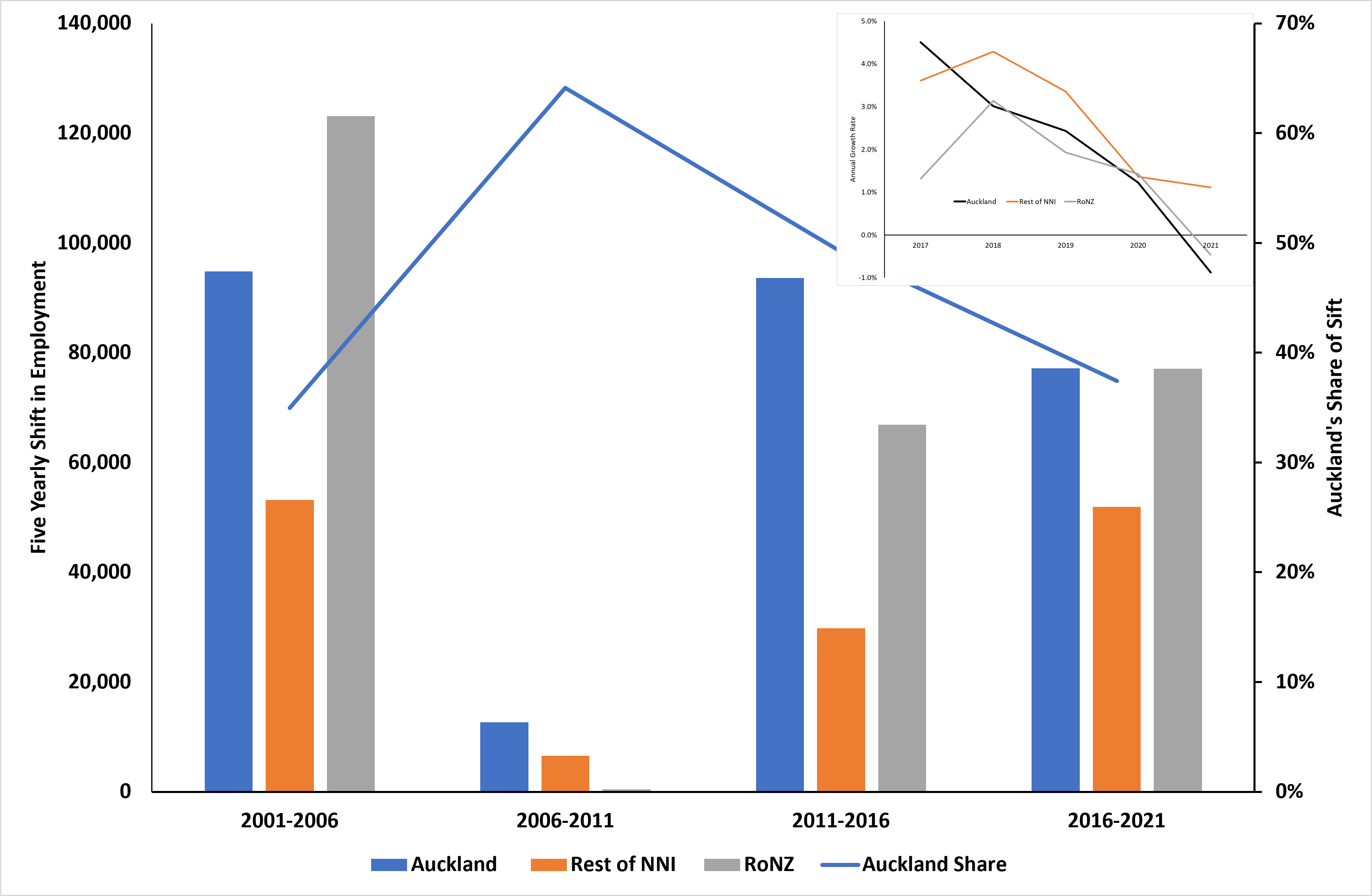
Unfortunately, the same goes for employment. Auckland’s job growth has trailed the rest of the country since the Global Financial Crisis (Figure 1), leading national growth into negative territory over the past five years (inset).

Figure 1: Regional Employment Growth, 2001-2021


This has not been helped by Auckland’s lagging productivity growth (Figure 2). While Wellington and Auckland still record the highest regional productivity, this is on the back of a tradition of falling primary and manufacturing jobs and increasing, well-paid white-collar employment in the business and government sectors.

Figure 2: Auckland’s Lagging Productivity Growth

     Source: Statistics NZ

According to Statistics NZ February counts, there have been significant falls in business services, manufacturing, logistics, and Covid-impacted hospitality. Only construction and public services (including education, health and social care, and government services) held up (Table 1).

Table 1: Recent Employment Changes in Auckland

Sector

2020-21

    Shift

        %

Primary

210

3.4%

Manufacturing

-2,400

-3.0%

Utilities

300

5.4%

Construction

3,600

5.8%

Logistics

-4,600

-4.6%

Retail

700

0.9%

Hospitality

-3,000

-5.1%

Business Services

-5,300

-2.6%

Public Services

4,100

2.3%

Personal Services

-700

-1.7%

Total   

-7,090

-0.9%

Structural Flaws

Unfortunately, this mix of employment is unlikely to help in the future. The downturn realised in 2021 may well prove to be a significant turning point (Figure 3).

For a start, the white-collar sectors, particularly in government and business administration, can be expected to shrink under the combined pressure of remote and flexible work practices and the loss of back-office occupations as advances in artificial intelligence automate an increasing array of transactional tasks. 

Government-funded services can be expected to follow the same path, particularly with the inevitable tightening of the fiscal belt in the face of ballooning global deficits and rising interest rates. 

How this will play out in the labour market – in favour of the administrators in the high rise offices or the providers on the ground – is yet to be seen. As the white-collar sectors stutter, though, the future of the labour market will rely increasingly on production and distribution, especially as construction also faces a sharp downturn.

Figure 3: Auckland’s Changing Employment Structure, 2001-2021


At the same time, possibly radical changes in world trade resulting from geopolitical upheavals and the increasing impact of climate change will favour regional economies with efficient production and distribution sectors. Among other things this is likely to sustain the movement of economically active households from Auckland to regional centres.

Time for a reset?

So here's my take on some of the hard issues facing Auckland against a background of a slowing world economy,an intensifying climate emergency, soft if not declining population growth, and a vulnerable labour market.

First, we have to revisit our infrastructure plans, acknowledging the vulnerability to climate change of key components, including the sewage treatment plant, airport, ports, rail, and downtown Auckland. Apart from the protective (and conservative) investment this will call for, the city needs to reduce its penchant for investment that does little more than prop up values in the central city, and instead address the liveability of the suburbs where the vast majority of people live and work. 

Infrastructure investment will have to be founded on sound evidence, be economically and environmentally sustainable, minimise fiscal and physical risk, and be shaped by reason rather than dogma, sound analysis rather than bureaucratic group think. 

Second, accept the logic of sustainable new suburbs, low impact housing (as opposed to multi-tiered, energy intensive, high density structures), and detached settlements supported by appropriately-scaled infrastructure, connected and networked by generous, multi-modal corridors.

Third, address the divisive problem of deprivation in Auckland, which has been reinforced by backward-looking policies favouring those who own property over those who don't; those who live in gentrified, well-serviced inner suburbs over those who don't; office over industrial employment; and large, centralised commercial centres over accessible local neighbour centres.       

Fourth, acknowledge the reality of climate change and its inevitable impact on properties and infrastructure in a city with an extensive shoreline. This may mean planning for resilience rather than containment, reducing the intensity of development in vulnerable areas among other things. The challenge is how to manage a long-term reduction of value of central and harbour edge sites over just one or two generations.

Finally, adopt a fiscally responsible approach to local government, reducing the bloated investment and operations that followed the creation of a monolithic city structure in 2010 and its quasi-commercial satellites and their opaque tolling operations. 

A good start could be made by acknowledging the reality of a slow-growth outlook by dismantling the Auckland Unitary Plan and its premise that centralised activity to support the historical concentration of wealth should be sustained at all costs. Replace it with light handed planning that fosters a region of connected communities, each meeting most of the needs of its residents locally. 

There is a need to provide accessible opportunities for work, play, and care in an era in which personal mobility could be compromised. This cannot be achieved seeking to contain growth (and now, perhaps, decline) in a highly centralised, high density, public transit-dependent city.  

Tuesday, December 7, 2021

Auckland Cannot Afford Light Rail

 A  long and winding trail

The October report from the Auckland Light Rail team promoting tunneled light rail from the City Centre to Mangere continues a history of reports built on aspiration rather than evidence. Like its predecessors, it is long past its use-by date.

A proposal for underground rapid rail proposed by American consultants failed to get traction in 1965, a classic case of a landmark project that could not be justified.  

That has not changed. Regular rejigging of the dream since 2009 is a case of a solution looking for a problem. In an earlier post I looked for a consistent rationale for light rail.  All I found was:

considerable variation in the policy trail regarding what LRT services might be required, and in what order: long-term cross-regional commuting? linking the inner Isthmus suburbs and the CBD? lifting capacity between the outer Isthmus suburbs and the CBD? or linking other employment centres (Westgate, the airport) with the CBD?

It seems a decision has now been made.  It is not a sound one.

Who will use it?

CBD commuters? Not many. Jobs in the CBD declined by 7% last year. Over half were in the business sectors that accounted for well over 50% of CBD growth in the previous 20 years. Expect further falls: this is the sector in which the largest share of jobs can be done remotely. 

As it is, the CBD accounts for just 14% of Auckland’s jobs. Its where fewer than half the commuters rely on cars. Most arrive from the northern or the eastern suburbs. Very few will be using light rail from the south, and most have bus options.

Inbound travellers? Forget it. Mass tourism has tanked and there is no saying whether or when numbers will recover.  Anyway, it relies on coaches. Independent travellers hire vehicles at the airport, or head directly to their accommodation by taxi or shuttle.  Some outbound travellers may use rail if they live nearby and are not encumbered by cases, while inbound locals will usually head directly home with their meeters and greeters.

Mangere workers? A few, perhaps. The area employs 34,000 people, 80% on and around Auckland Airport. The majority come from across South Auckland, though, and a few from the west. Light rail running north doesn’t meet their needs. 

Non-work trips? There may be demand for Isthmus-based trips for purposes other than commuting. But given the many origins and destinations for personal, social, retail, and education trips, flexible modern buses provide a far more cost-effective option.

So, it is hard to see market support for the optimistic projections underpinning the report (p32).


Does it stack up economically?

Even assuming the projection of boardings is reasonable, a total benefit of $11.6bn for Tunnelled Light Rail is no more than “broadly commensurate with costs” (at $10.3bn).  Costs and benefits are summed over 60 years and discounted at 4%. These are geared to justifying projects with high upfront costs and a long payback period; in other words, high risk, low productivity projects.

It gets worse. It is not clear that the costs of business and household disruption during construction have been factored in. The cost of “enabling infrastructure for ... urban development” (touted as a benefit, pp. 34-35) has not been included.  No provision appears to have been made for the erosion of  bus patronage. And the stated accuracy of the capital cost estimates still lies between -50% and +60%!

Quite simply, the project lacks economic justification. The consequences will be a huge cost to taxpayers and ratepayers: see here for an instructive (if more modest) example in Queensland.

Tail wagging the dog

The latest report is founded on the notion that light rail will work if accompanied by intensive corridor development to sustain Auckland’s projected growth. So, we will be shaping urban land use to support an ill-conceived project.  Unfortunately, the unspecified and uncosted “integrated urban interventions” required to make light rail work will add a lot more to project costs than benefits, compounding the risk of under-specifying and under-costing that have driven the cost blow-out, ongoing disruption, and delays on the totally uneconomic Central Rail Link.

Let’s get real

The report appears to be a self-serving document assembled by a range of agencies (“central and local government working together”) driven by a ”need to develop new living patterns.” There is scant regard for the public purse, or for how residents might like to live, a severe case of groupthink.

Here are some contrary arguments:

·       People have diverse mobility and access needs – fixed route public commuter options only address a small share of them. For many households and life stages automobility remains a high priority.

·       Bus transport in Auckland is working well , despite competition with revitalised heavy passenger rail.  Buses offer flexible operations, fiscally responsible investment, and continuous technical improvement.

·       Road-based transit will adapt with shared travel options in vehicles that are becoming safer, more automated, and less prone to failure (increasing the capacity of the existing road network).

·       With rising carbon prices, the uptake of electric light vehicles and hydrogen fueled heavy vehicles well within the 60-year framework makes any argument around transport emissions redundant. (A fraction of the cost of light rail could go a long way towards accelerating that transition).

·       The decentralisation of services, retailing and employment is a land use trend that promises to reduce trip intensity and length, by meeting more  household needs locally. It should be encouraged.

An elephant in the room: the growth fixation

A fixation on endless growth codified in Auckland’s Unitary Plan may be misleading policymakers. Whether or not a city of around 2.5m by 2050 is what people want or sustainable may no longer be moot.  Even before Covid struck, the driver of the exceptional post-GFC growth mesmerising super city planners – international migration – was turning down, while the net outflow of people to other parts of New Zealand was growing.

The halt to Auckland’s growth in 2021 is not a blip, it is response to the cyclical nature of international migration, a falling rate of natural increase, the decanting of an ageing population to provincial New Zealand, slowing employment growth, and the diminishing attraction of a city of over-priced housing and increasing congestion – which light rail will do little to alleviate. 

If productivity is driven down by ill-conceived mega-projects, expect emigration to prevail over the next decade undermining the growth assumptions on which Auckland’s planning and investment is based. The city needs a Plan B.

Rapid Rail to Mangere – A Wet Feat?

And there’s a second elephant: climate change. With heavy consumption of concrete and steel in tunneling, track laying, and station development, the proposal runs headlong into New Zealand’s commitment to halving net CO2 emissions by 2030. Light rail’s embodied emissions will exceed any gains from shifting people from cars and buses for decades.

Worse - if temperatures rise by even 1.5oC above the Climate Change datum (a prospect based on more realistic assumptions than those used to support light rail) both Auckland Airport and much of the Wynyard Quarter could be beneath the tideline.

Its time halt the expensive business of surveying, consulting, and concocting cases, pack up the train set, and concentrate on developing resilience in the existing transport system. Auckland is at a crossroad.  It may be that it is time to take the path of conserving resources, not squandering them

Thursday, April 30, 2015

Beyond constraint - urban form and housing affordablity


Resolving the housing affordability crisis

New Zealand’s rock star economy might just get deflated.  Prices in the Auckland and Christchurch housing markets are growing at unsustainable rates.  And when the bubble bursts, the implosion will be far-reaching.  The solution proposed here addresses the critical issue – how to get the land market working effectively and efficiently.  Without that, abstract aspirations for liveability in our main cities will, like a bubble, burst.

The solution is multi-faceted.  It lies in:
·     acknowledging the centrality of land supply;
·     changing how we think about urbanisation;
·     bringing multiple sites forward for development;
·     moving on six related fronts
  • change traditional mindsets
  •  realign institutions
  •   regulatory reform
  •   rethink infrastructure
  •   rethink funding
  •   back off excessive prescription
·     Moving to “why not?”

I expand on these points below.  If we can pull all this off, we might not only create a more productive, liveable city, we might also save the bubble blowers.


Sort the supply problem and the rest follows
It’s no news that that the housing affordability problem is multi-faceted. It’s tied up with fiscal and financial conditions, incomes, the size and structure of the market, inter-generational “competition”, the unpredictability of migration, the configuration of the building industry, and so on.   But without resolving supply constraints, and especially land supply, forget initiatives in these other areas. 

Get land supply right, though, and some of the other impediments might just melt away.
The issue really is land.  It is simple minded to think we can simply build our way out of a supply problem by Increasing building coverage and heights.  Boosting densities within cities might help, but raises a number of other issues: the cost of replacing or extending ageing and under-capacity infrastructure, how to spend our way out of congestion, redevelopment of transport corridors, and obesity and other health and social issues associated with confined and crowded living conditions.

My suggestions focus on Auckland but with relevance, I believe, for other settings.

Changing how we think about urbanisation

Get away from the obsession with contiguity.  Places aren’t urban simply because they are all joined up.  Urbanisation has its roots in transactions, not simply being there. Better to think about cites as networks – a mass of corridors linking nodes across a variegated landscape.  Take this approach and urbanisation and nature need no longer be in conflict. 

Think outside arbitrary administrative constructs. In Auckland, we might start with a focus on the super-regional corridors, and the quality and strength – or potential strength -- of our linkages with the smaller cities of Hamilton, Tauranga, and Whangarei.  Through this we can act beyond local constraints, as part of a potentially powerful and extensive crucible for New Zealand’s next round of development.

Breaking out the land
A growing city is not homogeneous.  Increasing land supply for urban development can and should take multiple forms.

Bring aboard multiple sites and forms of greenfield land. Within Auckland these can readily access and strengthen the region’s well-defined north-south access corridor.  They can also be distributed in such a way that they extend but work within the realities of sub-regional and sub-urban housing and labour markets. 

Think of townships as well connected urban nodes, without necessarily enveloping them within a creeping built landscape.  In Auckland we can apply well thought through extensions to villages and townships – Wellsford, Warkworth, and Waitoki in the north, Waimauku and Helensville in the west, Whitford and Clevedon in the east, Pukekohe, Tuakau, and Pokeno in the south, all surrounded by bush and farmland, linked to each other and to the urban core by a dense network of roads and, for some, by rail.   

And we can envisage of larger settlements closer to the existing built up areas, creating sub-urban communities with character as well as mass, some building on incipient development.  In Auckland we have multiple opportunities that align with existing sub-regional communities but assume their own form and character: Think Dairy Flat and Riverhead in the north, Kumeu in the west, Beachlands-Maraetai in the east; Drury, Ardmore, Runciman, and Karaka in the south.

And for traditionalists still wedded to singular edges, contiguity, and sprawl, seeking to preserve the city within arbitrary limits there are still possibilities for pushing existing suburban boundaries outward beyond, say, Albany, Orewa, and Silverdale in the north;  Massey and Hobsonville in the west; Wiri, Weymouth and Papakura in the south.

Suburban opportunities for selective intensification are still around.  They will increase as boomers age and voluntarily or otherwise relinquish their particular legacy of modest houses on large plots.  Medium density housing – perhaps by way of terrace houses and duplexes, low rise apartments, and especially residential villages (the retirement industry leads the way here) – offer the prospects of modest intensification without undermining communities or destroying the amenities which make the suburbs attractive in the first place.  But the costs can be high and progress slow.  Growing cities cannot wait around for successive generations to be bought or simply die off. 

Brownfield development may be seen as the silver bullet at the moment, because it implies swathes of already urbanised land simply waiting for the first sod to be re-turned and deliver intensive inner city settlement. Well that’s not so easy.  Issues around title consolidation, infrastructure rehabilitation, decontamination and the removal of hazardous materials, impacts on households and businesses in adjoining and proximate communities, the consequent battles for consenting, and the cost associated with often prolonged holding periods all-too-often turn brownfields into red ink or black holes.  Brownfield development is no solution for a supply constrained city.

While we are at it, let’s put the CBD into perspective.  It’s the leading office, visitor, and entertainment precinct in a city.  But it’s not where many of the city’s population lives, works or plays.  Sure, it may make sense to surround it with cheap apartments for Generation Zero to pass through, and where a very small group of the privileged may purchase a water-view, high amenity apartment.  But even in our wildest dreams, that’s not a path to the affordability or the capacity that a growing city requires.

So resolving the supply and affordability housing crisis presumably requires action on all those fronts, and in a wide range of localities.  One consequence of such an approach would be to reduce the capacity for speculative gains and land banking.  Another might be to encourage and sustain the development of significant, medium sized developers and builders, moderating current reliance on a small number of large developers on the one hand, and a large number of very small builders on the other. 

What to do?

All this is easily said.  So how is it to be done?  Here are some ideas.
First, we have to change from the traditionalists’ mind set.

What we have today, or what we thought of yesterday, may not suit tomorrow.  Tomorrow’s urbanisation may be more connected but less contiguous.  Greenfield development need not raise images of never-ending suburbs or houses to the horizon, but of settled landscapes that are penetrated and defined by natural features and green corridors.  Fields of green will stretch away from a diverse urbanised core interspersed with supplementary settlements – towns, villages, suburbs – connected to corridors that link a network of cities into a coherent economic and social unit across multiple administrative boundaries. 
But that’s getting ahead of ourselves.

More immediately, let’s throw off an outmoded mind set, and think about communities, not just housing.  Urbanisation involves business and work settings, community centres, local transport and recreational networks, and houses – detached, semi-detached, multi-storeyed, high and low density.  Don’t just count house sites when assessing potential; allow the land for a whole community.   Then let the landscape, the designers, the developers, and the market –future residents – bring it about (subject, always, to appropriate environmental constraints). And think about how connections with other centres work rather than how to maximise densities in any one of them.
Second, we need to realign our institutions.  Simply moving planners from one Auckland Council office to another was never going to ramp housing supply up quickly in Auckland.  Changing planning rules around Auckland’s plan may have slowed the process and dimmed the prospect for significant early movement as well.

How about setting up a government agency charged with assembling or defining the areas of land throughout Auckland and adjoining regions that might be brought to market?  A development corporation might tag or even purchase, consolidate, and then on-sell land for urbanisation, or put it out for tender to develop with some clear social objectives included. 
A complementary approach would be to draw on development agreements reached between council on behalf of community and developer.  These would spell out required (and realistic) outcomes as a condition of proceeding with the development of substantial parcels of land.  This approach should give more satisfactory outcomes than relying on the long-winded consent and appeal process encouraged by the Resource Management Act which may only achieve a compromise between public and private objectives. 

The proposed approach would need public input, though, so that as the agent of the community the local council would have a clear mandate regarding what provision for community amenities and infrastructure should be provided for in a development agreement.
Third, we need to change the regulatory framework within which it so is comfortable for traditional minds to remain wedded incrementalism and yesterday’s answers.  I have discussed elsewhere an initiative that might help, the rejigging of New Zealand’s environmental and local administrative legislation. 

Fourth, rethink infrastructure supply.  It may be time to get away from monopolistic suppliers wedded to old technologies and allow the innovative to seek out and apply more localised solutions to such matters as water supply, wastewater disposal, solid waste handling, and even power generation and distribution.  Of course, most alternative initiatives tend to be small in scale and currently relatively expensive to implement.  Costs tend to be dropping, though, and people may be prepared to pay a little more if resilience is increased and running costs are low.  One way or another the door needs opening to innovation, modernisation, and increased resilience, if for no other reason than to push current suppliers down this path. (I also wonder whether localised solutions are really more expensive than gold plating the capital works applied to large scale, monopolistic services).  
Fifth, rethink funding.  Why should future owners fund upfront the long-term infrastructure required when purchasing new homes given the value they bring to a community by playing an active role in its social and economic life as well as assuming a share of current fiscal liabilities. 

The real beneficiary of development is the party that sells land into a higher value use.  So a development levy on the profit realised from the sale of rural land into urban use, an underutilised brownfield site into intensification, or a large single-dwelling suburban site into apartments might be a more expeditious means of funding the works required to realise the enhanced potential.

Another possibility is to promote the commercial funding of infrastructure.  Privatisation of energy companies has facilitated this. Competition has been allowed into solid waste collection.   The creation of council controlled organisations for the provision of local infrastructure, however, hasn’t necessarily achieved improved funding. 

Commercial entities, whether investors or operators, can be expected to define an appropriate level of service and find efficient means to achieve it.  The long-term income streams may be an attractive proposition for bank lending (especially in deflationary times) or for the issue of high ranking bonds to raise finance.  They might also attract private and public equity.  There are plenty of examples – but we need more effective coverage of local infrastructure.  Regionalised entities for basic services can reflect the particular needs and circumstances of communities and tailor development options rather than simply extend the old system to new users.

Sixth, back off prescriptive plans by local councils and instead require that spatial plans set out long-term, broad-brush land use options and a commitment to where public money will be  spent on public services and amenities.  This should help shape a city in ways that the community wants.  It should also supply sufficient certainty for providers of infrastructure and services to plot their own investment priorities and programmes subject, of course, to their capabilities and risk management policies.  And where they fall short, expect other suppliers to step in.

The role of risk: moving to “Why not”
Risk and how it is treated may well lie at the heart of the problem.  Rather than evaluating risk and adopting protocols which allow for it without undermining the capacity to innovate and extend, policy makers in public institutions and monopolies appear to manage it by sticking with what they know, through imitation, replication, and repetition, and by the simple expedient of saying no: “Why should we?”  This is a sure recipe for constraint – of supply and of opportunity. 

I wonder if the biggest risk, the one that explains this conservative attitude, is that in pricking the housing bubble we might just bring the bubble blowers down.  Any significant readjustment of the housing market would hit the banking sector the hardest.  The American experience shows us what the banking sector does when it gets hit.  The community, economic and the political consequences of widespread mortgage foreclosures and business failures loom large over the whole housing crisis. 
If nothing else, an approach to managing the release of additional land supply that identifies and works through multiple sites and agencies, that helps to free up and fund the infrastructure sector, and boosts the development and construction sectors would moderate any such impact.  It might even allow the banks to participate in the transformation we need in the housing market  by moving some of the current funding from houses to infrastructure, .
Thursday, October 23, 2014

Driving Blind – Driverless Cars Ramp up the Risks for Rail Transit

In a brief radio interview yesterday I was asked about the possible consequences of driverless cars for Auckland’s planned big spend on its rail transit system.  My sound bite wasn’t too coherent, so here are some follow-up thoughts.

Driverless cars are coming

The driverless car is with us today, and its working.  The Minister of Transport’s expectation that it is “moving closer” is in line with international expectations and experience.[1]


In fact, the fully autonomous vehicle is just a further step – admittedly a big one – in the progressive reduction in the driver’s role in vehicle operation.  Automated train systems have operated since the 1960s.  Even aircraft today perform most operations automatically, and we are well on the way to the technology where they even interact to manage air traffic movements.

We can look forward to driverless road vehicles within the foreseeable future.  We are already well on the way.  Consider gains over the past 30 years by way of automatic transmission, power steering, automatic braking systems, electronic stability control, backing sensors, and most recently automated parking.  These innovations, while taking time to diffuse, reduce driver-related accidents and lift the efficiency of vehicle operation. 
Throw in the gains readily available from enhanced traffic management technologies, the use of GPS for better route planning and of GPS-derived Floating Car Data for real time traffic management and we have the promise of ongoing gains in efficiency in on-road vehicles and the prospect of a revolution in personal mobility.  And that’s on top of the promise of further gains in fuel efficiency following the 25% lift recorded by the US EPA between 2004 and 2014 and the impact of alternative fuels.


What are the consequences?

The Rand Corporation recently published a comprehensive study on Autonomous Vehicle Technology that is worth a look.

From this and my take some of the gains we might expect from driverless cars include: 
  • The costs of travel will diminish as drivers are frees up to engage in other tasks and as greater travel efficiencies are realised;
  • Lower accident costs because there will be fewer of them;
  • Vehicle efficiency will improve as a result of: the capacity to use lighter materials; easier uptake of alternative fuels; smoother acceleration and deceleration;
  • Development of more efficient parking facilities;
  • Network productivity gains from higher vehicle densities and fewer disruptive events. 

This may not mean less congestion.  Numbers on the road may increase as people currently transport disadvantaged find it easier to access and operate motor vehicles.  Cost reductions are likely to boost car use.  And such gains may encourage more long-distance commuting.

On the other hand, the use of driverless vehicles is part of a convergence changing the environmental impact of motoring.  Together with the shift to smart cars for urban travel and to alternative fuels, driverless cars will contribute to a fall in the emission of particulates and CO2 .

A new mode of public transport?

Driverless cars offer a new take on public transport by providing for shared vehicles that respond to individual demands.  They may be held in private pools; widely accessible vehicles may be in public ownership, or vehicles may held and maintained by a variety of organisations, including specialist operators (equivalent to today’s taxi or rental companies), bodies corporate on behalf of residents of apartments, or businesses on behalf of employees.  

Such arrangements will support the higher densities favoured by urban planners, reduce the costs of car ownership, and maintain efficient point-to-point travel.  In addition, vehicle pooling may encourage more trip sharing, lifting car occupancies.

Supporting fixed route public transport

So what will the consequences be for buses and trains?  Buses should benefit, both in terms of enhanced vehicle flow and, in due course, through adoption of the technology.  This could lead to smaller, more flexible buses with variable routing better meeting demand.  In other words, buses will be part of the revolution in personal mobility resulting from autonomous vehicle development.

Rail is a different matter.  In increasingly fragmented cities, fixed route transit is at a distinct disadvantage, especially when it is based on a limited network.  For rail to penetrate in Auckland it requires either effective feeder road access to park-and-ride facilities or the clustering of high density dwellings and jobs around already busy stations. 

Driverless cars could contribute to both of these.  The intensity of local cross-commuting required to support park-and-ride facilities may be eased by use of driverless cars.  The heightened congestion associated with higher densities in the inner city and on arterial roads targeted by the Auckland plan might be similarly eased by their adoption by residents as well as commuters.

But will driverless cars save rail?

While the adoption of driverless cars might marginally improve the effectiveness of rail transit, this will still be constrained by the intrinsic limits of rail .  Unlike rail, personal vehicles do not run empty for much of the time.  They operate from point to point and largely avoid the high time costs of transfers.  There may be some waiting time in accessing shared cars, but the inconvenience is a lot less than that associated with fixed timetables.  And with technical gains the externalities associated with car use will continue to fall.

Traffic flows should improve, costs fall, and convenience increase for car users.  Car-based transport will be more accessible, reducing the numbers dependent on traditional public transport.  Buses will also be more effective.  None of these positive outcomes bode well for rail with its high capital costs, the lumpy nature of investment, and high operating, maintenance, and depreciation costs.  What they do is increase the fiscal risk associated with Auckland’s plans for an inner city rail loop or extensions to the airport or North Shore as the alternative of road-based transport becomes that much more attractive.

The risk profile of rail investment is already high.  The prospect of driverless cars raises it higher.

Driving a revolution?

In just 25 years we have seen revolutions that have fundamentally changed the ways in which we deal with information, communicate, work, socialise and recreate.  There is every reason to expect the advent of driverless cars to signal a similar revolution in personal mobility. 

Who today would buy a typewriter, a telex machine, or a floppy disk?  So why buy a railway?


[1]              See for example recent articles in The Scotsman and Forbes Magazine.