Showing posts with label urban form. Show all posts

Thursday, June 9, 2022

Auckland at a Turning Point 2: Marking Down the Labour Market

 Reality Bites

For some years I have been calling out the over-exuberant growth expectations behind Auckland’s planning.  I have also argued that creating a single council to pursue a compact city strategy was wrong.  First, the supercity structure was always going to increase the cost of local government while diminishing its responsiveness to the increasing diversity of communities and changing external conditions.  Second, planning based on intensification and centralisation was always going to frustrate the growth it was meant to accommodate, pumping up house prices, business costs, and congestion. 

These were hardly popular views, and it gives me no pleasure to say today that the chickens have come home to roost. Emigration is rising. Housing demand is softening, although too late to prevent a growing division between expanded renter and shrunken owner classes. The need for social housing is well up, while the already high cost of home building keeps getting higher. (And through grandiose spending plans, Auckland Council has become a fiscal and economic liability). 

Meantime, in neighbouring Australia wages are higher, house prices and living costs lower, and the labour market buoyant, leading once more to the loss of young and productive people across the Tasman. And, more Aucklanders heading for the regions will compound the slump in the residential market – in prices and in building (but not necessarily the cost of building).

The region has for decades taken the lion’s share of the country’s population growth, but that dominance is fast diminishing.

The labour market: pausing or turning?

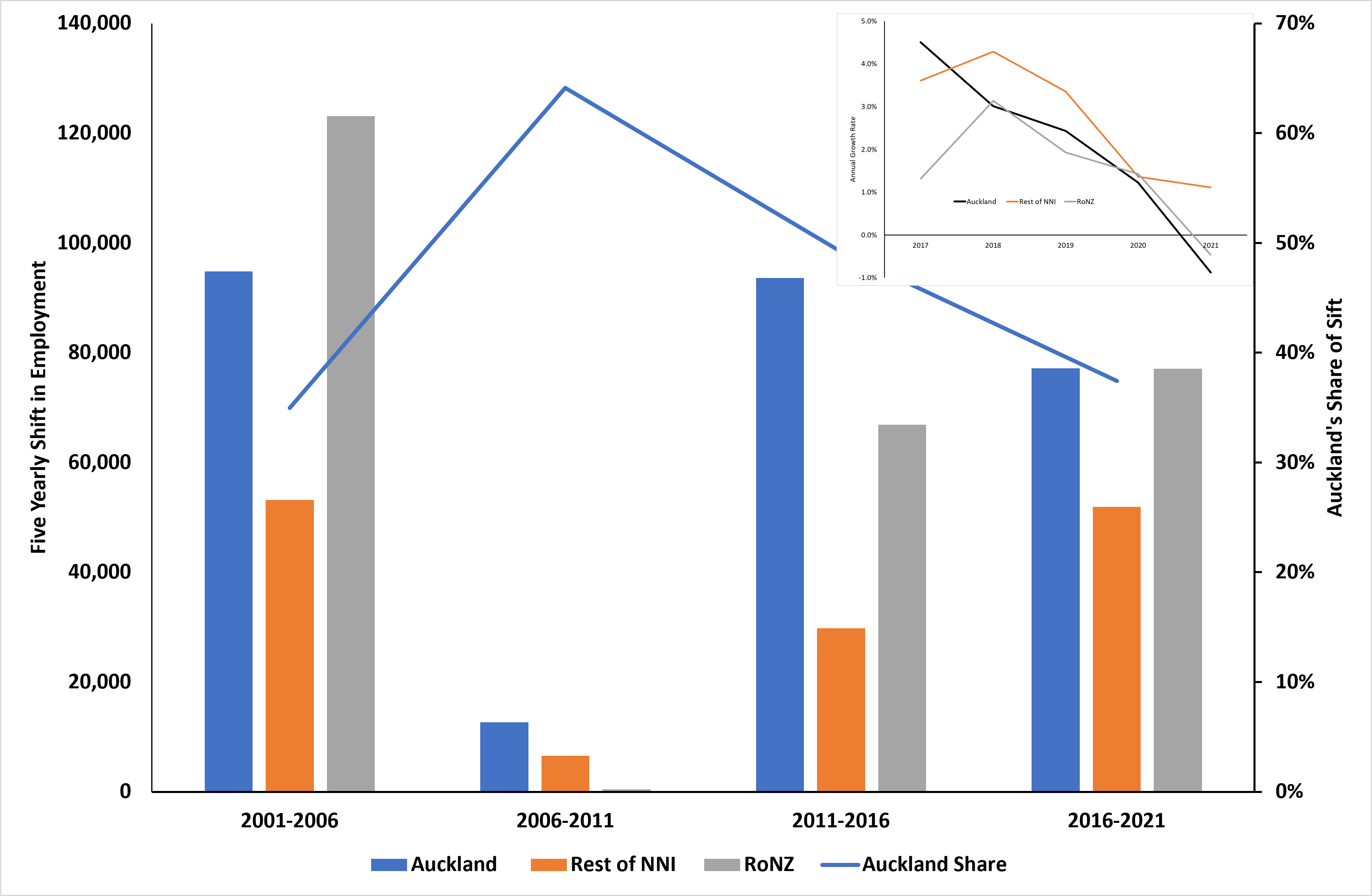
Unfortunately, the same goes for employment. Auckland’s job growth has trailed the rest of the country since the Global Financial Crisis (Figure 1), leading national growth into negative territory over the past five years (inset).

Figure 1: Regional Employment Growth, 2001-2021


This has not been helped by Auckland’s lagging productivity growth (Figure 2). While Wellington and Auckland still record the highest regional productivity, this is on the back of a tradition of falling primary and manufacturing jobs and increasing, well-paid white-collar employment in the business and government sectors.

Figure 2: Auckland’s Lagging Productivity Growth

     Source: Statistics NZ

According to Statistics NZ February counts, there have been significant falls in business services, manufacturing, logistics, and Covid-impacted hospitality. Only construction and public services (including education, health and social care, and government services) held up (Table 1).

Table 1: Recent Employment Changes in Auckland

Sector

2020-21

    Shift

        %

Primary

210

3.4%

Manufacturing

-2,400

-3.0%

Utilities

300

5.4%

Construction

3,600

5.8%

Logistics

-4,600

-4.6%

Retail

700

0.9%

Hospitality

-3,000

-5.1%

Business Services

-5,300

-2.6%

Public Services

4,100

2.3%

Personal Services

-700

-1.7%

Total   

-7,090

-0.9%

Structural Flaws

Unfortunately, this mix of employment is unlikely to help in the future. The downturn realised in 2021 may well prove to be a significant turning point (Figure 3).

For a start, the white-collar sectors, particularly in government and business administration, can be expected to shrink under the combined pressure of remote and flexible work practices and the loss of back-office occupations as advances in artificial intelligence automate an increasing array of transactional tasks. 

Government-funded services can be expected to follow the same path, particularly with the inevitable tightening of the fiscal belt in the face of ballooning global deficits and rising interest rates. 

How this will play out in the labour market – in favour of the administrators in the high rise offices or the providers on the ground – is yet to be seen. As the white-collar sectors stutter, though, the future of the labour market will rely increasingly on production and distribution, especially as construction also faces a sharp downturn.

Figure 3: Auckland’s Changing Employment Structure, 2001-2021


At the same time, possibly radical changes in world trade resulting from geopolitical upheavals and the increasing impact of climate change will favour regional economies with efficient production and distribution sectors. Among other things this is likely to sustain the movement of economically active households from Auckland to regional centres.

Time for a reset?

So here's my take on some of the hard issues facing Auckland against a background of a slowing world economy,an intensifying climate emergency, soft if not declining population growth, and a vulnerable labour market.

First, we have to revisit our infrastructure plans, acknowledging the vulnerability to climate change of key components, including the sewage treatment plant, airport, ports, rail, and downtown Auckland. Apart from the protective (and conservative) investment this will call for, the city needs to reduce its penchant for investment that does little more than prop up values in the central city, and instead address the liveability of the suburbs where the vast majority of people live and work. 

Infrastructure investment will have to be founded on sound evidence, be economically and environmentally sustainable, minimise fiscal and physical risk, and be shaped by reason rather than dogma, sound analysis rather than bureaucratic group think. 

Second, accept the logic of sustainable new suburbs, low impact housing (as opposed to multi-tiered, energy intensive, high density structures), and detached settlements supported by appropriately-scaled infrastructure, connected and networked by generous, multi-modal corridors.

Third, address the divisive problem of deprivation in Auckland, which has been reinforced by backward-looking policies favouring those who own property over those who don't; those who live in gentrified, well-serviced inner suburbs over those who don't; office over industrial employment; and large, centralised commercial centres over accessible local neighbour centres.       

Fourth, acknowledge the reality of climate change and its inevitable impact on properties and infrastructure in a city with an extensive shoreline. This may mean planning for resilience rather than containment, reducing the intensity of development in vulnerable areas among other things. The challenge is how to manage a long-term reduction of value of central and harbour edge sites over just one or two generations.

Finally, adopt a fiscally responsible approach to local government, reducing the bloated investment and operations that followed the creation of a monolithic city structure in 2010 and its quasi-commercial satellites and their opaque tolling operations. 

A good start could be made by acknowledging the reality of a slow-growth outlook by dismantling the Auckland Unitary Plan and its premise that centralised activity to support the historical concentration of wealth should be sustained at all costs. Replace it with light handed planning that fosters a region of connected communities, each meeting most of the needs of its residents locally. 

There is a need to provide accessible opportunities for work, play, and care in an era in which personal mobility could be compromised. This cannot be achieved seeking to contain growth (and now, perhaps, decline) in a highly centralised, high density, public transit-dependent city.  

Wednesday, February 9, 2022

Auckland Light Rail – Sinking a Tunnel or Sinking a City?


Light Rail: A solution in search of a problem

Auckland has seen that the creation of commissions, teams, or working parties to implement simple-minded solutions to complex problems allows little room for debate on alternatives.  Like the creation of the supercity and Auckland’s Central Rail Link, the proposed CBD to Airport tunnelled light rail is a solution in search of a problem.

In Tuesday’s NZ Herald economist Tim Hazledine strips Auckland’s congestion problem back to basics. He raises some facts that seem to have been overlooked: the limited nature of the problem, the availability of congestion pricing to resolve it, the changing of CBD work, the low utility of a service stopping at 18 stations over a short distance, and Auckland’s “topsy turvey topography”.

There's not a lot to add to his critique, but here’s some more on the environmental issues and changes in Auckland’s growth, both of which render the LRT already obsolete.

Climate Emergency: Yeah?  Nah?…

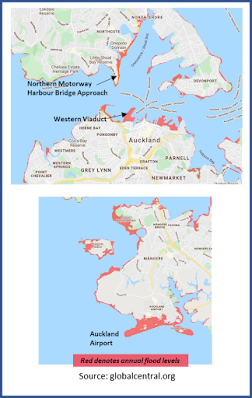
In 2019 Auckland Council declared a Climate Emergency. In January 2022 the Government announced new light rail (LRT) from the CBD to Auckland Airport, flying in the face of that declaration: risk maps (1) put the LRT terminals, the airport and the CBD’s Western Viaduct, below the annual flood level before the end of the 60-year horizon used to justify it.

Inundation Prospects 2080: Auckland CBD and Airport


Even without sea level rise and with heroic assumptions about Auckland’s growth (more on that below), the project makes no economic sense. An abysmally low return, the likelihood of delays, and inevitable cost blowouts will undermine productivity.

And on the environmental front, tunnelling and the demand for concrete and steel will boost medium-term CO2 emissions despite the declared climate emergency (2).  The project may not even achieve a net greenhouse reduction before flooding at both ends of the line stymies its operations. (3)

So, there is an elephant in the tunnel.

It gets worse.

The Minister of Transport also announced another major construction project, a “second” harbour crossing, predictably endorsed by lobby group, Infrastructure New Zealand.  

The new crossing will  parallel the Auckland Harbour Bridge and share its northern approach. Unfortunately, this portion of State Highway One road already floods in severe storms. Given that it will flood more frequently as the sea level rises and storm events increase, the planned crossing will do little for network resilience. (4)

(We should mention that there is already a second crossing. Between West Auckland and North Shore, it will not be directly affected by climate change because its approaches are well above sea level).

Tunnel-vision

Acknowledging a Climate Emergency should lead to reconsideration of urban form and infrastructure to deal with the structural drivers of emissions. Current plans for excessive public investment will provide disproportionate private benefits to the small minority of Auckland’s households and businesses that benefit from the operation of fixed-route, heavily subsidised  transit services. Turning attention, instead, to land use and the relationship where most people live and work (which is clearly not the CBD) should lead to more much equitable urban form and investment outcomes. 

The government, the council, and its agencies should be revising their long-term plans to recognise the reality of climate change and shifting urban form, and aim to reduce transport demand without penalising mobility. Instead, their aim seems to be to cement in historical city form in the face of unprecedented climate change .

The plans will seriously disrupt lives and, through poor use of capital and crowding out better investment, undermine productivity. On the plus side (?), they should sustain an oligopolistic civil engineering and infrastructure sector and prop up CBD and on-route property values. 

Incidentally, climate myopia is not confined to the public sector. It’s fascinating to see businesses taking up new, ”green” commercial space in downtown Auckland’s future flood zone, while vacancies increase in the elevated uptown offices they are abandoning.

Auckland at a tipping point

We need to acknowledge another elephant.

With Covid people think about a new normal in terms of public health. Equally significant, though, Covid has accelerated shifts already changing Auckland’s growth path. Consider the combined impacts of:

·         A cyclical downturn in immigration, which commenced in 2018, accelerated under Covid;

·         A wage-disadvantaged economy will prolong the migration deficit beyond the “Covid effect”;

·         Technology advances and changing work practices undermining central city growth;

·         Land, service, and congestion costs leading to the decentralisation of industry;

·         Changes in attitudes to work, careers, and lifestyle reshaping how and where people want to live, and where and when they want to work;

·         A continuing population push out of Auckland;

·         Technology changes in the distribution of goods (bar codes, robotics, consumer-focused logistics) and services (decentralisation and democratisation through IT and AI);

·         An increasingly obsolete 20th Century model of urban and commercial hierarchies behind Auckland’s long-term planning.

Auckland is unlikely to grow to match the bullish projections used by the current crop of city planners and builders.  Nor will urban design based on debatable assumptions about where people should live and work. 

Revising urban form - planning for dispersal

With or without climate change, it is time to ease over-investment in that ageing tiara, the city centre, and put more into our scattered diamonds, emerging urban villages, and our pearls on a string – the centres of Wellsford, Warkworth, Drury, Pokeno, Tuakau, and the like – north and south of Auckland.

It is time to focus investment on the infrastructure and amenity needs of a range of urban centers rather than on mindlessly sinking public funds into the CBD. This means developing and maintaining well-balanced, localised land use and services. On the transport front, decentralised investment can facilitate more active travel options and demand-based vehicle sharing. Flexible bus options can operate both within and between centres, the latter on strong corridor connections among them.

Fortuitously, supporting dispersal within and beyond the city means spreading the risks associated with climate change and adopting defensive rather than intensification strategies on the waterfront. 

Dealing with the risk of climate change

Of course, that’s just an opinion from outside the tent.

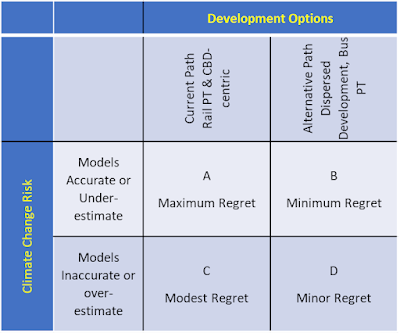
But here's my take on these diverging scenarios in the form of a risk/regret matrix.  The risks (“How likely are the climate change projections?”) fall on the vertical axis, the planning options on the horizontal axis (“Which development path shall we take”?)


The case for changing direction

The current investment path (which leads to cell A or C) looks wrong.  If we stay with it and the models are about right, we will write off a lot of investment and lower our ability to react to the impacts of climate change (Cell A). Even if the climate settles, we may still look back with regret at misplaced and under-costed commitments (Cell C). 

If, on the other hand, we shift to dispersed and flexible investment and the climate remains benign (Cell D), we would at least have a policy framework that should cope well with slower growth and reduce inequities within the city.

Finally, if we are fully exposed to the rigours of an unstable climate, then catering for dispersed development and opting for flexible public transport would provide the resilience and capacity to bounce back from climate disruption (Cell B).  The consequences of climate change may not be pleasant, but we will be better placed to deal with them. There will be regret – it’s too late to wind back the climate change clock – but we will have done our best to minimise it.

By the way …

Globally, the money-printing presses are grinding to a halt. The prospect that inflation will ease central and local government deficits will be offset, in part, by rising interest rates.  Money is no longer free, or debt without consequence. The case for major transport projects must be robust rather than shaky, definitive rather than indicative.

Proceed with the LRT and Auckland’s Climate Emergency will generate a fiscal crisis and see the integrity of Auckland’s infrastructure undermined as the promise and pressures of growth diminish, fiscal and financial liabilities increase, and the sea encroaches.


[1]           Based on the 2021 IPCC global warming consensus

[2]              For example, cement releases over 0.5tCO2/tonne and steel over 1t/tonne produced.

[3]              The Technical Appendices behind the Indicative Business Case, including Carbon Assessment, are not yet                      published.

[4]              Flooding could be offset by extensive and expensive raising of the road (State Highway One), some of which will       be needed anyway to keep the existing bridge functional. Expanding it at the same time, over 8km of vulnerable           shoreline, raises a whole lot more issues (and costs). though.

Friday, February 26, 2021

In defence of NIMBYs

Why? Not in my backyard!  Or, why not in my backyard? 

NIMBYism is seen as a negative, a selfish not-in-my-backyard reaction by residents to any significant changes proposed for their neighbourhood. But is that always justified? It depends on who you ask. 

Certainly slamming NIMBYs makes for good press, offering developers and planners the high ground in the encounter between haves, with their commitment to the current environment, and the have-nots.  The have-nots are those (other than investors) that stand to benefit from the proposed change, be they drivers on an expanded highway, commuters on new transit connections, potential dwellers in new apartments, or workers  in new factories, warehouses, and offices.

So, it is interesting when a media commentator like Kerrie McIvor defends the NIMBYs, setting out the neighbourhood issues associated with residential intensification from the ground up.

People who know asking the questions that need to be answered

There is increasing recognition of the legitimacy of local communities  reacting against development that threatens their established way of life.  The people most immediately impacted may be the best-placed to ask critical questions.  They also have the right to ask them if council commitment to citizen engagement is genuine, and if developers rely on claims of consultation to legitimise their proposals.

Denigrating all local reaction under the singular label NIMBY also obscures the different motivations of opponents.  It fails to distinguish those that resist change as a matter of course from those whose insights and experience raise legitimate questions.

Protecting the right to do it badly?

Dismissing local opposition risks lowering the barrier to ill-conceived projects. If a proposal cannot meet the challenges raised, questions must be asked about its merits.  No development may be better than poor development.  Or, modification, even moderation, may lead to enhancements that make a project more acceptable to locals and more attractive to the beneficiaries. Local opposition can lead to better outcomes all round, leading to better standards, design, and delivery.  

Unfortunately, weak or token consultation, entrenched positions taken by advisors, and blue sky financial or fiscal expectations by promoters lead to the discounting of local concerns and expertise.  This is especially so when local issues emerge only when advanced plans, to which promoters are already committed, are revealed.

There is more to NIMBYism, then, than resistance for resistance’s sake. After all, the challenge for planning is to reconcile development with environmental and community values.

Busting down the doors – clogging up the pipes

Take the response to the failing housing market over the last two decades.  Neighbourhood resistance to intensification garners little sympathy from decision-makers and commentators who see it as pitch by those with secure housing in established neighbourhoods against the interests of those in need of similar shelter and security. 

This is an over-simplification.

Housing policies have relied too often on the simplistic adoption of residential intensification to boost supply.  When planners and developers choose a location for intensification because of its attractiveness the risk is that they end up creating the antithesis of what was there.  Nobody wins.

The result is reliance on expensive land within boundaries often ill-equipped to cope . Affordable housing under these circumstances means building low cost, low quality dwellings, with high embodied and operational energy demands and all-too-often construction defects.  It may also mean a high bill from over-loaded, ageing, and capacity-constrained infrastructure: the roads, pipes, parks, and waterways needing rehabilitation and expansion which ratepayers – existing residents and new – will have to pay for.

Looking out for the beneficiaries

Simple-minded solutions to difficult problems – a shortage of dwellings in this case – can lead to outcomes that benefit no-one. Dig deeper into the aspirations of the unhoused, and it may be that the opponents of increasing density in urban areas are championing what many people want and what apartment living fails to provide.

Local communities resisting change can be seen as the champions of the values that people today see as rights: clean air, water clean enough to swim and fish in (and drink), access to sunlight and green space, limits on noise and light pollution, a degree of visual and aural privacy, reasonable access to private services and public amenities, and security.

There is no guarantee that the aspirations of future residents will be met by pockets of high-density housing. Evidence from a study of five UK cities indicates that denser neighbourhoods are still more likely to provide poor access to quality green space”, while their residents “are more likely to feel unsafe [and] experience less social interaction than in lower density suburbs”.

Too often, the rush to compensate long-standing failures in the housing market has led to alternatives that fail to deliver the real benefits of decent housing to the intended beneficiaries – the occupants of the new dwellings.

Equity should not rely on lowering standards

So, when communities call for protection of their living space and the quality of the local built environment, they are not denying it to others. They are calling on those that can make a difference to do so in ways that add to the appeal of urban living, rather than destroy it. Urban plans that prioritise the destruction of organic suburban spaces to deliver sub-standard outcomes are about pursuing a form of urbanism that lowers the quality of city living and frustrates the pursuit of equity by lowering the well-being and expectations of an entire generation, not simply those that happen to make the most noise about it.

Monday, September 3, 2018

What happens when carrying capacity is exceeded? The planning debate we have to have


In 250 words …
The failures of Auckland’s Unitary Plan could have been avoided if it had been based on the physical capacity of Auckland to absorb development, rather than on how to cram in as many households as we can imagine over the next forty years.  This would have focused on the population that the environment can sustain, not the population that comes from extrapolating sseveral years of high migration gains.
Using carrying capacity as a starting point helps rationalise infrastructure investment and enables aspirations for growth beyond “natural” limits to be assessed relative to the additional investment required. It would reveal the fiscal impact of the Plan based on understanding the City's environmental assets and residents’ needs.
Unfortunately, the approach adopted seeks to accommodate inflated population projections in a confined space, raising questions around environmental impacts, economic consequences, fiscal outcomes, and sustainable growth.
It may not be too late to adopt a carrying capacity approach.  It may mean redrawing the map of development and density,though, rethinking connections within Auckland and with other cities, and backing off over-specification of what is allowed, focusing instead  on desirable outcomes within the physical and social limits to growth. 
It also means debating some difficult questions: How many residents is too many? How do we enforce limits? And how does this impact on the national economy?  


A Plan for What?
Auckland’s Unitary Plan appears to be unravelling. Congestion continues to grow.  The infrastructure spending required to keep the city functioning and its waters clean keeps growing. The Central Rail Link budget is blowing out (as far as we know!)  The public costs of running the city are running away.   Between 2012 and 2017 operating expenses jumped 21% in (in 2017 dollars) while population increased by around 12%: that’s an 8% increase per head.  Borrowing went from around $3,600 per resident to $5,010, a 40% jump.

And now the taxpayer is being called on to top up investment as central government steps in to fund a transport package for Auckland, even as additional charges are placed on residents and households by way of fuel levies and, possibly, a bed tax on private short-term rentals.  

And now the government is overriding the Unitary Plan, a plan with  rules that even the people who wrote them – the City’s planners –  apparently struggle to interpret.

The Unitary Plan is all about the metrics of fitting more and more people into a confined space and pouring resources into the central city in the hope that it may retain its commercially dominant role.  This may serve some interests.  But how well does it serve Auckland’s population at large, now and in the future and what are the long-term consequences for the physical and social environments?

Even as our understanding of the risks of over development improves, the Unitary Plan and ad hoc responses to its short-comings threaten to reduce resilience and sustainability by over-running Auckland’s carrying capacity, particularly by emphasis on intensification on the Isthmus.


Fiscal, Economic, and Social Consequences
The fact that we are investing hand over fist in infrastructure may provide some reassurance about the capacity to accommodate growth, but carries its own risks. Infrastructure that is not justified economically, retrofitting under-capacity, aged, or obsolete infrastructure, and unbudgeted overruns all undermine productivity. Getting infrastructure investment right, based on sound land use planning among other things, is critical to sustaining the investment necessary for well-founded city growth.  Otherwise, inadequate or inappropriate infrastructure will undermine investment and productivity.  

Increased housing and commuting costs that arise from a deficient urban plan will also do so.  High living costs translate into high costs of employment.[1]  These, like high land costs and infrastructure deficiencies, also reduce the attraction of the City for productive investment. 

A large and growing rental population is one result of high living costs.  This is inherently destabilising.  It places downward pressure on birth rates as young households delay or abrogate child raising.  It makes recruitment of specialist skills more difficult.  And it creates a large fotloose component within the community, something that also increases the cost of employment.  All this, in turn, raises the risk that what has been a modest net population loss from Auckland to other parts of the country over the past thirty years will accelerate..

The current building boom arising from catch-up infrastructure and housing projects is creating a whole set of issues of its own. Cost overruns are inevitable when major private and public projects, and the drive to boost housing intensify competition for scarce skills and labour, for land, and materials.

Thinking about carrying capacity
If this gloomy prognosis has any crediblity, then its time to confront the question, how much growth can Auckland physically accommodate?

Identifying physical carrying capacity means addressing questions with a mix of science and subjectivity: when will the things we value about the Auckland environment be lost if we over-develop? Where are the environmental thresholds? At what point do we call a halt to untrammelled growth and consider alternative development strategies? 

 While politically difficult, here are some of the matters we must consider.  First, at what population level will we have transformed the city to the point that it hits the threshold for sustainability, and how do we identify that?  When might our valued natural and productive marine and terrestrial ecosystems collapse, or be threatened with collapse from the weight of overuse?  And what are the issues raised by recognising that we cannot continue to pursue hgrowth at any costs?

The answers will change as our knowledge of natural systems increases, along with out capacity to manage the effects of development.  But if we look at the state of our coastal waters, the fishing resources of the Gulf, the risks to our forests, and the dwindling of indigenous wildlife, it seems these things have not weighed in sufficiently in our planning.

Another question: how do we factor resilience into our plans for Auckland, especially in the face of climate change?  This may call for a retreat from the foreshore, or the funding of major structures in the marine environment, and the development of new transport corridors if the central city is not to be subject to regular and inceasingly severe disruption (the more we pack into the CBD, the mre far-reaching extreme weather events will become).. 

There is also a question of equity and social justice: how far are particular sections of the community going to be required to carry the cost of excessive growth, or be excluded from the benefits?

Finally, we need to address the role of infrastructure.  The wrong infrastructure, or infrastructure in the wrong place, will effectively reduce the region’s carrying capacity, just as too little will.  Our refusal to think of the treatment of transport corridors and future demands on them is already emerging as a significant limiting factor.

Start with “How much?” and then move on to “How?”
Identifying and managing carrying capacity is more fundamental than simply debating trains versus cars, public versus private transport, high density versus low density housing, mixed use versus single use zones, heritage versus high rise, greenfields versus brownfields, malls versus local centres, or city centre versus suburbs.

If we had been planning for Auckland based on how much growth the City can support without undermining its natural, economic, and social resources, we would likely have produced a plan quite different from the hotchpotch we are saddled with today. 

And the argument that Auckland must grow if the nation is to grow is simplistic. We already seem to have reached the point at which the diseconomies of agglomeration in the city exceed any benefits it might offer business.  Auckland’s GDP growth from 2000 to 2017, for example, lagged the rest of New Zealand, placing 14th out of the 15 regions listed by Statistics New Zealand. [2]

It is time to rethink the strategy for our largest urban centre.

Getting ahead
A plan that builds from the ground up would explore technical thresholds and how they might change in the future. It would highlight the unknown and provide for flexibility and adaptability, rather than rigidity and over-written rules. There would be greater clarity on what is not allowed, and why, and ideally a scientifically informed consensus on the limits to growth.

At a practical level the plan would provide the canvas, not the paint.  It would accept that a growing city comprises a collection of connected communities and that, given their varying character and capacity, one set of rules for all does not work.  The attempt at homogeneity has led to a complex current plan which points the way to overdevelopment and uninspiring sprawl. Better that we recognise, among other things, the significance of diverse suburbs and  suburban life and work, and ensure that within them the public realm supports healthy communities.

It should recognise that containing development within an urban boundary is flawed in a growing city, boosting the externalities that occur when carrying capacity is exceeded, and diminishing the quality of life. These include bottlenecks and congestion, infrastructure and service failures, high employment and service costs, water and air pollution, and vulnerability to disruption.  

That contiguity does not lead to efficient urban development, is a reality finally being realised. We should be looking at the evolution of satellite towns and cities in the regional hinterland, and at the quality of connections with them and with provincial cities and regions (although they too will have to address carrying capacity issues as they gear up for a migration-driven boost to growth).  

The promotion of satellite towns and cities, adapting smart growth principles to the sites selected, incorporating modern and sustainable infrastructure solutions, and providing for diverse and dynamic investment and employment, increases the capacity to adapt urbanisation to changing circumstances.  It potentially provides for greater degree of resilience locally, through a high level of community self-sufficiency, and regionally, through multiple sites of production and consumption, and plentiful, accessible  green space. 

A ground-up plan will set broad land-use parameters within which infrastructure services should be provided, and guidelines for their assessment set out, rather than seeking to prescribe and control what will happen, where, and when . The timing and capacity of infrastructure cannot be pre-determined too far ahead of the growth it might cater for without excessive costs and risk. Any major public infrastructure provided for in a plan should be subject to rigorous economic, fiscal, and environmental evaluation. Uneconomic infrastructure is costly and a drag on productivity. 

Local or commercial infrastructure might simply be assessed on environmental and safety standards and the disciplines of finance and market left to determine development within those parameters.

Beyond Auckland
The fact that central government is becoming more and more involved in sorting out Auckland’s problems may signal time for a fundamental change in how we do urban development.[3]  The development of Wellington, for example, has benefited from modest growth.  However, today growth pressure is mounting, pressure which could well undermine its claim to be the world’s coolest little capital.

Wellington, like urban centres Tauranga and Queenstown, faces growth challenges that arise in large part from the costs and constraints physical character imposes on growth.  The challenge many New Zealand centres face is how to retain the character that makes them both appealing and viable in the face of new growth pressures.  

In Auckland and beyond, it is time to address how much centres might grow based not on naïve cohort projections but on just how much we can accommodate.  It is a shift in urban planning and policy that raises some uncomfortable issues.  But it may be better to address them sooner rather than later, before we destroy the very qualities that make our settlements and cities prosperous.


[1]              This negative impact may be masked by methods used to estimate regional productivity that assume high wages reflect greater output per worker rather than compensation for excessive housing and commuting costs. 

[3]              The fact that the Government asked the Productivity Commission to visit ground aero with respect to urban planning says as much.