Showing posts with label urban planning. Show all posts

Thursday, June 9, 2022

Auckland at a Turning Point 2: Marking Down the Labour Market

 Reality Bites

For some years I have been calling out the over-exuberant growth expectations behind Auckland’s planning.  I have also argued that creating a single council to pursue a compact city strategy was wrong.  First, the supercity structure was always going to increase the cost of local government while diminishing its responsiveness to the increasing diversity of communities and changing external conditions.  Second, planning based on intensification and centralisation was always going to frustrate the growth it was meant to accommodate, pumping up house prices, business costs, and congestion. 

These were hardly popular views, and it gives me no pleasure to say today that the chickens have come home to roost. Emigration is rising. Housing demand is softening, although too late to prevent a growing division between expanded renter and shrunken owner classes. The need for social housing is well up, while the already high cost of home building keeps getting higher. (And through grandiose spending plans, Auckland Council has become a fiscal and economic liability). 

Meantime, in neighbouring Australia wages are higher, house prices and living costs lower, and the labour market buoyant, leading once more to the loss of young and productive people across the Tasman. And, more Aucklanders heading for the regions will compound the slump in the residential market – in prices and in building (but not necessarily the cost of building).

The region has for decades taken the lion’s share of the country’s population growth, but that dominance is fast diminishing.

The labour market: pausing or turning?

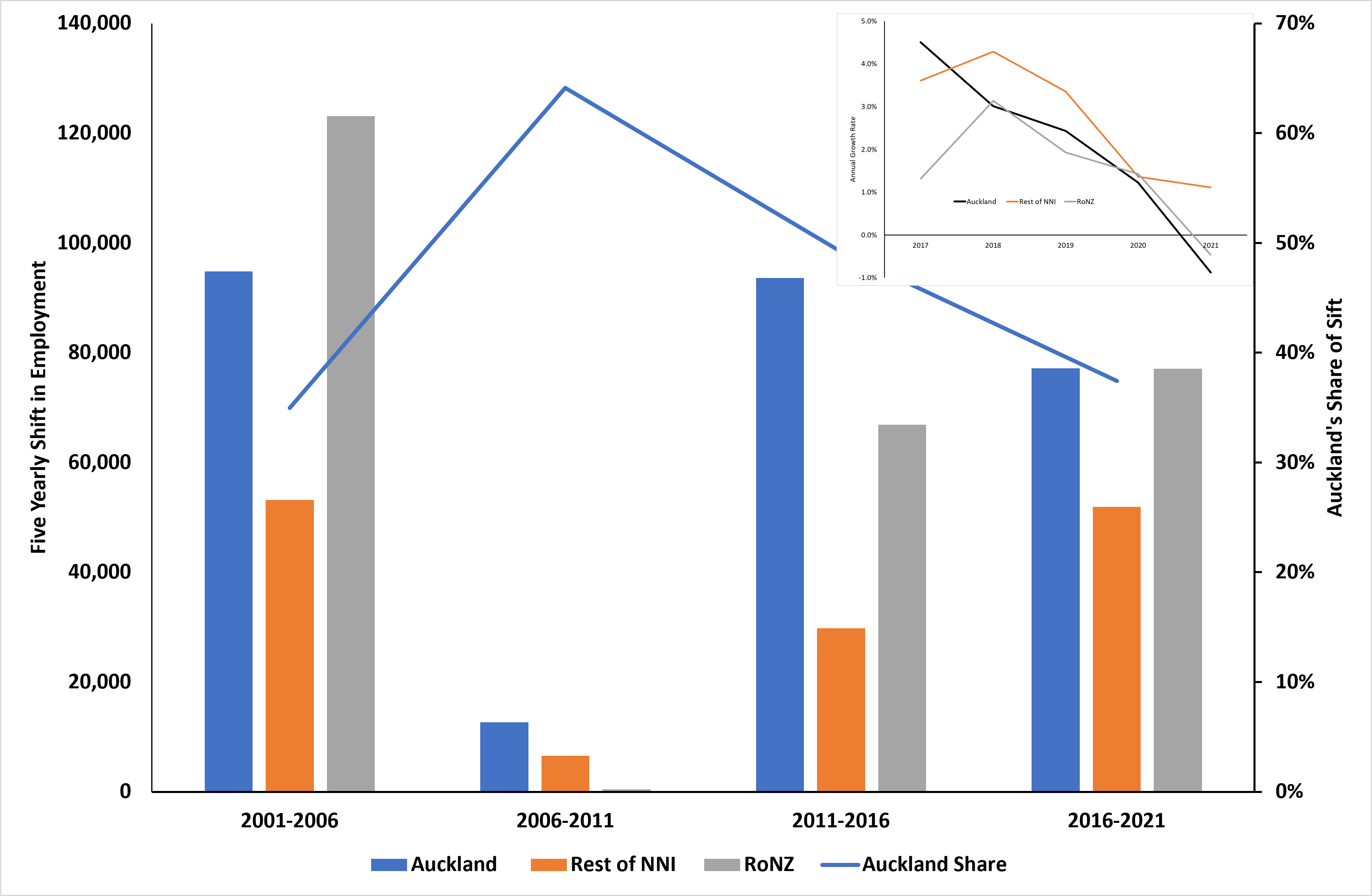
Unfortunately, the same goes for employment. Auckland’s job growth has trailed the rest of the country since the Global Financial Crisis (Figure 1), leading national growth into negative territory over the past five years (inset).

Figure 1: Regional Employment Growth, 2001-2021


This has not been helped by Auckland’s lagging productivity growth (Figure 2). While Wellington and Auckland still record the highest regional productivity, this is on the back of a tradition of falling primary and manufacturing jobs and increasing, well-paid white-collar employment in the business and government sectors.

Figure 2: Auckland’s Lagging Productivity Growth

     Source: Statistics NZ

According to Statistics NZ February counts, there have been significant falls in business services, manufacturing, logistics, and Covid-impacted hospitality. Only construction and public services (including education, health and social care, and government services) held up (Table 1).

Table 1: Recent Employment Changes in Auckland

Sector

2020-21

    Shift

        %

Primary

210

3.4%

Manufacturing

-2,400

-3.0%

Utilities

300

5.4%

Construction

3,600

5.8%

Logistics

-4,600

-4.6%

Retail

700

0.9%

Hospitality

-3,000

-5.1%

Business Services

-5,300

-2.6%

Public Services

4,100

2.3%

Personal Services

-700

-1.7%

Total   

-7,090

-0.9%

Structural Flaws

Unfortunately, this mix of employment is unlikely to help in the future. The downturn realised in 2021 may well prove to be a significant turning point (Figure 3).

For a start, the white-collar sectors, particularly in government and business administration, can be expected to shrink under the combined pressure of remote and flexible work practices and the loss of back-office occupations as advances in artificial intelligence automate an increasing array of transactional tasks. 

Government-funded services can be expected to follow the same path, particularly with the inevitable tightening of the fiscal belt in the face of ballooning global deficits and rising interest rates. 

How this will play out in the labour market – in favour of the administrators in the high rise offices or the providers on the ground – is yet to be seen. As the white-collar sectors stutter, though, the future of the labour market will rely increasingly on production and distribution, especially as construction also faces a sharp downturn.

Figure 3: Auckland’s Changing Employment Structure, 2001-2021


At the same time, possibly radical changes in world trade resulting from geopolitical upheavals and the increasing impact of climate change will favour regional economies with efficient production and distribution sectors. Among other things this is likely to sustain the movement of economically active households from Auckland to regional centres.

Time for a reset?

So here's my take on some of the hard issues facing Auckland against a background of a slowing world economy,an intensifying climate emergency, soft if not declining population growth, and a vulnerable labour market.

First, we have to revisit our infrastructure plans, acknowledging the vulnerability to climate change of key components, including the sewage treatment plant, airport, ports, rail, and downtown Auckland. Apart from the protective (and conservative) investment this will call for, the city needs to reduce its penchant for investment that does little more than prop up values in the central city, and instead address the liveability of the suburbs where the vast majority of people live and work. 

Infrastructure investment will have to be founded on sound evidence, be economically and environmentally sustainable, minimise fiscal and physical risk, and be shaped by reason rather than dogma, sound analysis rather than bureaucratic group think. 

Second, accept the logic of sustainable new suburbs, low impact housing (as opposed to multi-tiered, energy intensive, high density structures), and detached settlements supported by appropriately-scaled infrastructure, connected and networked by generous, multi-modal corridors.

Third, address the divisive problem of deprivation in Auckland, which has been reinforced by backward-looking policies favouring those who own property over those who don't; those who live in gentrified, well-serviced inner suburbs over those who don't; office over industrial employment; and large, centralised commercial centres over accessible local neighbour centres.       

Fourth, acknowledge the reality of climate change and its inevitable impact on properties and infrastructure in a city with an extensive shoreline. This may mean planning for resilience rather than containment, reducing the intensity of development in vulnerable areas among other things. The challenge is how to manage a long-term reduction of value of central and harbour edge sites over just one or two generations.

Finally, adopt a fiscally responsible approach to local government, reducing the bloated investment and operations that followed the creation of a monolithic city structure in 2010 and its quasi-commercial satellites and their opaque tolling operations. 

A good start could be made by acknowledging the reality of a slow-growth outlook by dismantling the Auckland Unitary Plan and its premise that centralised activity to support the historical concentration of wealth should be sustained at all costs. Replace it with light handed planning that fosters a region of connected communities, each meeting most of the needs of its residents locally. 

There is a need to provide accessible opportunities for work, play, and care in an era in which personal mobility could be compromised. This cannot be achieved seeking to contain growth (and now, perhaps, decline) in a highly centralised, high density, public transit-dependent city.  

Thursday, April 20, 2017

Auckland facing Hobson’s Choice: Expansion or Implosion?


Choosing Auckland
In 1840, the first New Zealand Governor, William Hobson, sailed into Waitemata Harbour and chose Auckland as the country’s new capital.  The harbour offered ease of embarkation and disembarkation.  Fertile coastal lands meant that settlers could grow food crops, and the local Maori tribe, Ngati Whatua, welcomed the promise of protection and trade that European settlement offered.

Auckland’s early fortunes fluctuated.  The city could only be reached easily from other early settlements in New Zealand by sea .  It was on an isthmus divided by two harbours, crossed by flood-prone creeks and peppered with swamps.  In addition, tribes to the south resisted the sale and alienation of their fertile Waikato lands, stalling expansion of European settlement until the late 1860s. 

The emergence of New Zealand’s first city
Auckland survived, though, even when New Zealand’s administrative capital was moved to Wellington, 600km south, in 1865.  Rivers were bridged, wetlands drained, waterfronts reclaimed, and a railway pushed into the fertile and now subdued Waikato region, and beyond. 

The city prospered in the 20th Century, dominating the import and distribution of manufactured goods and exporting regional produce.  Consequently, it developed a substantial import-substitution manufacturing sector, boosted by protectionist policies introduced in the 1930s. 

When the economy was deregulated, starting in the late 1970s,  manufacturing’s role contracted.  However, its presence and the city’s trading heritage set Auckland up as the primary service centre in New Zealand, providing business, professional, trade, and financial services to production (much of it taking place beyond its boundaries), and catering to the needs of a steadily growing population.

Primacy in the 21st century
The cumulative advantages of scale served Auckland well.  Although still a small city globally (347th on the UN Population Division’s 2015 city size listing), it accounts for 32% of New Zealand’s population and 34% of its employment. This primacy reflects the importance of consolidating human skills and resources in a small country (population 4.8 million, less than the Sydney metropolitan area’s 5 million 2,000km across the Tasman Sea) and the low density of settlement over the rest of New Zealand.

Auckland remains New Zealand’s centre of disembarkation.  Even as increasing numbers of residents decamp for hinterland towns and smaller cities, New Zealanders returning from overseas, new migrants, and international students tend to make Auckland their first stop (Figure 1).  As a result, the city accounted for 50% of national population growth over the five years to 2016, a period of exceptional migration gains.


Figure 1: Net Long-Term Migration, Auckland and the Rest of New Zealand, 1991-2016

Reaching choke point?

Today Hobson’s site seems unsuited for a city of even 1.5million, let alone the 2+ million projected for the not-too-distant future.  Physical constraints have put the squeeze on housing and transport.  Ageing underground infrastructure struggles to cope.  The city may be approaching – or have already exceeded –Tamaki Makarau’s carrying capacity.  That, though, is not something that Auckland Council seems ready to contemplate.

Unfortunately, an obtuse planning response to the challenge of growth is set to squander the human and physical capital already invested in the city, and to mar its natural qualities.  A plan preoccupied with boosting employment and housing in a confined CBD and to promote increasingly intensive development on the Isthmus looks set to throttle growth. 

Externalities abounding
The outcome for Auckland of a strategy of consolidation and centralisation in is already apparent:

·         Under-capacity public and private transport services and a lack of redundancy in the networks lead to frequent stoppages on road and rail throughout the city, compounding already excessive congestion;

·         Restrictive land use policies create a hopeless backlog of housing demand with severe economic and social impacts (see, for example, the presentation of economic commentator Shamubeel Eaqub in Joel Cayford’s Reflections on Auckland Planning);

·         Increasing costs to business – the costs of employment, congestion, business disruption, and even space for growth raise the spectre of slowing investment, diminishing productivity, and income growth;

·         Grossly inflated land prices feed into high housing costs, distorting the supply chain and generating a new middle-underclass, defined more by frustrated housing aspirations than by educational or family shortcomings;

·         Failures in water, sewage, and stormwater systems threaten the health of the harbours and estuaries which give Auckland its character;

·         A growing likelihood that significant natural events (such as intense low pressure storms) will increasingly bring a congested city, its critical services, and its centre to a halt.

It’s the geography, Stupid
The response to the challenge of growth has been to promote increasing densities in the central city and, latterly, in the inner suburbs, a strategy that is deeply flawed for this city (something I have laboured in earlier postings: e.g., here and here). 

This strategy flies in the face of Auckland’s geography and the natural constraints it imposes.  It raises the prospect of fiscal failure for the council because it requires high cost works with limited if any productivity gains while compounding depreciation, maintenance, capital and servicing liabilities. 

The city will be hard placed to meet its financial commitments if the current crisis of growth accelerates, further lifting ratepayer costs and reducing the affordability of Auckland to business and households alike.  And any slowdown would only compound the city’s fiscal miseries.

Hobson’s choice
So now we are faced with our own Hobson’s choice (Thomas’ not William’s): the city has little option but to find ways to expand.  It is time to embrace new approaches to land and its use in the region, how and where it is developed, and how it is connected.

Given that Auckland Council seems hell-bent on promoting consolidation on a site ill-suited to it and in a culture in which it will work only for a few, this will only happen with a dramatic shift in thinking.  That might come if Government moves quickly to embrace the proposals for revamping urban planning through the rewrite of the Resource Management Act and shake up of the planning establishment proposed by the Productivity Commission.  The choices for Auckland are narrowing.

Tuesday, October 7, 2014

Hardening Arteries: Intensification and Inner City Congestion

Apartment creep
One tool in the compact cities toolbox is boosting residential densities along arterial roads. It’s a tool that should be used sparingly.

According to a report by Bernard Orsman in the New Zealand Herald, it’s a tool giving rise to mixed reactions along Great North Road, Grey Lynn, as planners apparently exercise their discretion to
rise above the proposed Auckland Unitary Plan by allowing apartment buildings higher than originally planned.

This raises questions over the rights (or otherwise) of current residents to sunshine and views and over the impact of new bulky structures on heritage areas and buildings in the inner city (Figure 1). To be fair, the car yards along Great North Road hardly merit preservation, although adjoining and nearby villas may do. The trouble is, though, this is not an isolated example.

The other issue worrying residents is simply the impact of so many more people – and their cars. Allowing six storeys where the original intention was four (something that some local residents could apparently live with) makes for a substantial increase.

Do inner city apartments stack up?

I questioned the economics of higher density inner city dwellings in Auckland some time ago. These concerns are confirmed by developer Brady Nixon in the Herald article. 

He cited costs of $8,000 to $10,000 per sqm to build apartments in Auckland. Evidently a single bedroom 54sqm apartment at North Apartments on Great North Road cost $11,462/sqm. Brady compares this with $3,150/sqm for a 238sqm house at Flatbush.

Figure 1: Planned North Apartments, Great North Rd
Before

    Source: Google Earth

 After

    Source: http://www.northapartments.co.nz/

Good for some
There is no doubt that inner city[1] living suits particular markets, primarily the 20 to 30 age group, people in tertiary education, starting jobs, building careers, yet to develop permanent relationships. This is demonstrated in my last post.
 
But that will account for well under 20% of population growth over the next 15 years [2]. How many of this group and recent immigrants (40% of inner city residents lived overseas five years ago) will be able to afford well designed apartments?

What can we deliver?
The push for higher buildings is necessary so that high inner city land and development costs can be spread across more apartments. Adding storeys is one approach to achieving commercial returns. Sacrificing quality is another, an approach apparently adopted for a number of projects in the past. While that may suit a transient inner city population, it does little for the quality of urban design and may well contribute to social problems in the long term.

Can boomers give apartments a lift?
Another way forward if intensification is the objective might be to produce apartments that appeal to more mature households, and simply leave Gen Y to their own devices (not a happy prospect).   Apparently there has been a surge in demand for apartment living among older people in Brisbane. But, they are looking for well-appointed three-bedroom apartments where they can sustain – and afford – a lifestyle similar to the one they are used to. Given the economics of apartment development it’s difficult to see a similar standard and style in Auckland being affordable among those ageing boomers who might favour inner city living.

As it is, they are not likely to account for a lot of demand. Only 1.2% of Aucklanders aged over 50 lived in the inner city in 2013 (compared with 5.2% of Aucklanders aged between 15 and 39). So what is the likelihood that inner city apartments might appeal to more of them?

 Not great. Members of the boomer demographic in Auckland are
suburban dwellers, used to space and privacy. Retirement villages offer a suburban alternative that does not require their withdrawal from the communities where they currently live if they choose to trade down. They still receive the benefits of low maintenance and security while retaining access to a little space and privacy. 

Congestion - the elephant in the apartment
That might be just as well because mindlessly boosting residential development on arterial roads promises simply to compound Auckland’s congestion problems.

We know higher densities are associated with higher congestion. Auckland’s geography means it already performs poorly on this count. The Tom Tom Congestion Index confirms this.  

When the 2013 congestion index for 65 American and Australasian cities is plotted against population density (sourced from the
Demographia website) Auckland sits among the worst performers – Vancouver, Sydney, Los Angeles, and San Francisco (Figure 2).
 
Figure 2: Population Density and Congestion


Inner city dwellers still use cars

Intensifying housing on arterial roads can only make that worse. While proponents of inner city living might cite a reduction in car use as a result of proximity to work and cafes to justify it, the reality is that people use cars for more than commuting and dining.

 In 2013 inner city households owned over 10,000 cars (0.7 per household or 43/ha). Doubling or tripling the number of residents by promoting inner city apartments will lead to increasing congestion, especially when that takes place on arterial roads. 


Given that households in the inner suburbs (the rest of the Isthmus) focus their travel on those roads and owned nearly 200,000 cars in 2013 (1.6/household and 14/ha), Auckland’s main arterials could well resemble parking lots rather than roads in the future. 

Gilding the lily
This makes the before and after images in Figure 1 somewhat misleading given that there is no sign of additional activity in the second image despite the prospect that the North Apartments alone will house another 40 to 60 inhabitants.

This omission reminds me of a pitch for intensifying dwellings around arterial roads in Melbourne. The before and after images in Figure 3 were intended to illustrate how Australian cities might be transformed. Detached houses are replaced by continuous four to six storey apartments, all achieved, if we are to accept the rendering,  with no more people on the footpath, no more rubbish bins to sidestep, no more tram stops and no more cars .
 
Figure 3: Half a transformation: packed apartments, quiet street


Less haste, more thought
Oh that it were so easy: that with the stroke of a pen and perhaps a little airbrushing planners could solve our housing problems and retain a pleasant, uncongested inner city environment.

The reality is that it is hard to make apartment living work in the inner city, and short-sighted simply dumping it onto arterial roads.  Unthinkingly reaching for the sky is a risky response to the need for more housing, especially affordable housing. A lot more thought needs to go into this particular planning tool before it is applied in such a cavalier manner.

[1] The CBD and “outer central city” as defined in my
previous post
[2] This estimate is based on the Statistics New Zealand age-specific Auckland population projections (2006 base). This groups 15 to 39 year olds together, a group projected to account for 27% of growth from 2016 to 2031, compared with 61% among the over 40s.

Wednesday, April 24, 2013

Denial as Defence: Time to Acknowledge Flaws in Auckland’s Unitary Plan


Evidence mounts, resistance increases
Yet another research project has reminded us what the majority of Aucklanders already know.  Most of them want to live in suburbs, and prefer detached to multi-unit dwellings.  Yet the Auckland Council – or at least the majority of councillors and their planners – apparently remains in denial.  Through the Auckland Plan and now the Unitary Plan the Council continues to elevate higher density dwelling in and around town centres, the CBD, and arterial roads as the principal response to Auckland's growth potential and to a longstanding and growing housing crisis confronting the city.

But the evidence is mounting that it is not an appropriate plan for accommodating growth and maintaining Auckland’s liveability on either economic or environmental grounds.  And the signs that Aucklanders will resist the plan are mounting, even as the Council aims to rush it through with limited consultation and even more limited evidence.

Who are we planning for?
This left me wondering just who will occupy the medium- to high-density residential precincts planned to shape our future. To get an insight into this I went back to the 2006 Census to find out who lived in the inner city in Auckland, Wellington, and Christchurch.[1] 

I looked at a number of indicators for the inner suburbs, and compared them with the same statistics for the respective regions (which include their peri-urban catchments, additional urban areas in Wellington, and towns in Canterbury). 
The results are displayed in the various graphs at the end of this blog. Take a look. 
The evidence is compelling.  Inner city dwellers tend to be in rental accommodation, they are generally younger – with a marked absence of families – they are less likely to be currently married or in a civil union, they haven’t been at their current address very long, and are likely to have moved in from other parts of New Zealand and overseas. 

Central Auckland residents –passing through
This pattern prevails in each of the three inner city areas considered to a greater or lesser extent.  But it looks most pronounced in Auckland, so I delved a little deeper there.  The table tells the story: inner Auckland by no means represents Auckland or Aucklanders.


Inner Auckland – an area in which small, often multi-unit dwellings tend to prevail – is where people appear to touch down briefly, not where they settle.  They come from elsewhere, and do not stay for long.  They are predominantly young adults, a significant share being students.  Older people are not necessarily attracted to the smaller units of inner city living – something we looked at in an earlier post.  Most residents in inner Auckland are not in permanent relationships.  And the people who are tend to be are couples without children. 

So where is the evidence that suggests that the plan will be widely accepted?
If this is the sort of profile we might relate to inner city and multi-unit living (apartments, terraces, and the like) the Auckland plan could be on shaky ground. It may well be shaped around the residential preferences of a distinct (and diminishing) minority: younger, transitional and transient people and households. 

Of course, the data is dated, and there has been a pretty intensive PR effort by the council and its supporters to push a plan telling us that we ard ready to make the shift to higher density.  But surely such a push should be based on evidence that suggests many more people are prepared to accept a radical change in the lifestyles that typified Auckland in the recent past?  And while the evidence cited here against the plan is a little dated, I have seen none that suggests tastes and behaviours have changed that much.
So we are left with a radical shift in the way we think about and live in Auckland, apparently founded on little more than supposition and dogma.

More evidence is around the corner
Perhaps we should seek a stay in play at least until the 2013 census results become available later this year and early next.  Maybe they will show the sort of shift that might increase the credibility for the plan. Either way, it makes sense to actually wait and see, if for no other reason than what the most recent data tells us about the housing market and residents' preferences is bound to be brought to bear as communities dig in to resist it. 

And no need to hold up the main task
And with a more relaxed (and realistic) timetable for the Unitary Plan, the Council could push ahead in a more focused way with a series of changes under currently operative plans – or even in partnership with central government through special legislation – to address the city’s housing crisis.  And it could do that without getting caught up in the growing debate over a plan that at the moment is not standing up well to community (and perhaps even government) scrutiny.


[1]         Including the following Census area Units:
Auckland: Central West, Freemans Bay, Central East, Newton, Grafton West, Grafton East
Wellington: Lambton, Willis Street-Cambridge Tce, Thorndon-Tinakori Rd, Aro St-Nairn St, Mt Cook-Wallace St, Mt Victoria West
Christchurch: Cathedral Square, Hagley Park, Avon Loop, Mona Vale, Riccarton West, Riccarton, Riccarton Sth, Merivale, St Albans West, St Albans East, Edgeware
 
 The Inner City is Different ....
 

 Note: Married includes civil unions